All articles

What We’re Reading (Week Ending 17 October 2021)

The best articles we’ve read in recent times on a wide range of topics, including investing, business, and the world in general.

We’ve constantly been sharing a list of our recent reads in our weekly emails for The Good Investors.

Do subscribe for our weekly updates through the orange box in the blog (it’s on the side if you’re using a computer, and all the way at the bottom if you’re using mobile) – it’s free!

But since our readership-audience for The Good Investors is wider than our subscriber base, we think sharing the reading list regularly on the blog itself can benefit even more people. The articles we share touch on a wide range of topics, including investing, business, and the world in general.

Here are the articles for the week ending 17 October 2021:

1. Nature Shows How This All Works – Morgan Housel

California has been devastated by wildfires for a decade. Back to back, year after year. Long-term droughts turned forests into dry tinder.

So everyone was elated when 2017 brought one of the wettest winters California had seen in recent memory. It was epic. Parts of Lake Tahoe received – I’m not making this up – more than 65 feet of snow in a few months. The six-year drought was declared over.

But the fires just got worse. The wettest year in memory was followed by “the deadliest and most destructive wildfire season on record.” And those two things were actually related.

Record rain in 2017 meant a surge of vegetation growth. It was called a super bloom, and it caused even desert towns to be covered in green.

That seemed great, but it had a hidden risk: A dry 2018 summer turned that record vegetation into a record amount of dry kindling to fuel new fires.

So record rain led to record fire.

2. The DMZ Partners Owners’ Manual – Soumil S. Zaveri

We will invest in a business only if we are willing to potentially own it for a decade. This is important to us for four reasons: 1) It ensures we focus on quality businesses whose fundamentals are likely to persist over time. As per Nassim Taleb’s advice, we will think long and hard about resilience in alternative future outcomes (say, in times of regulatory, economic or competitive stress). 2) We are not too excited by the prospect of getting rewarded on the basis of how an asset ought to be valued by catalysts in the medium term – nor do we want to deceive ourselves into believing that we have any expertise in being able to do so. Even if successful, such an investing style may deviate us from the prospect of compounding capital over decades by remaining patiently invested in exemplary companies. We would be deceiving ourselves in assuming that we can be better capital allocators than the people that run among the most outstanding companies we can find. 3) We are blessed with the privilege of patience – we intend to monetize it by identifying exceptional management teams, building franchises with immense scalability prospects over decades. This importantly allows us to partake in the “optionality value” that emanates from the bounty of unforeseeable surprises that accompany the actions of exceptional people. Experience has shown that it would be a folly to discount this phenomenon. Finally, 4) Taking an unusually long-view also gives us the advantage of an uncrowded spot as institutional imperatives often force professionals to check their relative performance scorecard every quarter, half-year or year. Our approach, if deployed well, is designed to help us deliver superior outcomes over a decade. Having an exemplary outcome over a decade is not the same as having ten exceptional one-year outcomes, much like a five-year-plan is not five good one-year plans.

We will never choose to own an asset solely based on valuation. No point bringing home junk for free – it still occupies valuable and limited space. Opportunity costs are very real, which we will remain acutely aware of. Gregory Mankiw wastes no time reminding microeconomics students that “the cost of something is what you give up to get it.” We take his advice to heart. To put it in practical terms, if you own a poorly governed, mediocre business solely because it is seemingly a mouth-watering bargain – time is effectively your enemy. The longer you must wait for your value to be realized, the greater the chances that the mediocre business faces setbacks or that inept management commits grave errors – in effect, permanently impairing your investment. We want time to be firmly on our side. In owning wonderful businesses run by exemplary people, time is an exceptionally potent tailwind!

3. DocuSign CEO Dan Springer offers surprising lessons learned from four years as a stay-at-home dad sandwiched between two IPOs – Byron Deeter and Dan Springer

Dan considers his role as a father to be his greatest career accomplishment. He believes that to be a great leader, you need a firm sense of what’s important in life—beyond just the confines of your office walls. What’s more, Dan says that the skills you develop as a caregiver will serve you greatly as a leader and mentor.

And he also points out that, while he’s gotten praise and media attention for his decision to pause his career for fatherhood, making a similar decision is considered wholly unremarkable for his female leader counterparts. “My feminist friends say if I were a woman, nobody would be asking me why I paused my career at its height. They say, ‘Well, you should have been staying home with your kids anyway, at least a little bit.’ As a dude sitting here, we should be aware we have these biases.”

Now Dan can’t unsee the double standards that plague career-oriented women. “Feedback is truly a gift,” he says. “So thank you to all the women and men in my life who are great feminists and have helped educate me in areas I was missing.”

Both his personal experience and burgeoning awareness of bias prompted him to do things differently as the leader of DocuSign. He created a parental leave program that guarantees all employees who become biological or adoptive parents six months of paid leave. “I hope everyone copies it. If you’re a founder out there, take away my competitive advantage. Offer this to your employees,” says Dan. “They will love you, and you’d be amazed how quick it’ll transform your culture.”

4. Slackers of the World, Unite! – Ellen Cushing

Eight years, more than 10 million users, and an acquisition bigger than the GDP of El Salvador later, Slack has managed to mostly hold on to the cachet of its early days. “All of the other messaging apps that we tested just felt sort of corporatey,” says Melanie Pinola, who wrote the Wirecutter review that declared Slack “by far” the best team-messaging app. “And the ones that were fun were really just imitations of Slack.” The user-experience researcher Michele Ronsen, who has done work for Slack and other global brands, told me that she’s seen no other product evoke such uniformly positive reactions among consumers. “When I recruit and conduct studies, over half of the people volunteer their love for the product and the platform and the benefits, completely unsolicited,” she said. “That does not happen very often.”

This is great for Slack, and also a little ridiculous: Enterprise software is meant to blend in, silently and only semi-effectively wringing more productivity out of us before we can call it a day. It is not supposed to create zealous brand loyalists. But Slack so thoroughly permeates companies’ culture that it changes them. It changes the language of the office and the texture of the workday. It enables a sui generis kind of communication, one that’s chatty, fast, stream-of-consciousness, and always on; one that often feels less like an email than a group text. It is work software that insinuated itself into our lives precisely by feeling unlike work software—and, in turn, it has made work feel less like work…

…On Slack, everyone has the same size megaphone, regardless of hierarchy or chain of command. And between the jokes and the special channels and the spontaneity and the freewheeling way of talking to your colleagues—who are also kind of your friends—it encourages a type of personal expression that is new to the American workplace.

A decade or two ago, identity formation, friendship, meaning-making, and political agitation were much more likely to be the things we did on nights and weekends. Now they’re central to work. If you’re an entry-level grunt, this might be thrilling. If you’re a boss, it can be scary. In August, Apple blocked employees from starting a Slack channel devoted to discussing pay equity, citing a policy that Slack activity “must advance the work, deliverables, or mission of Apple departments and teams.” (Channels about dad jokes, pets, and gaming were left alone.) In April, Basecamp, which makes software with a function similar to Slack’s, banned “societal and political” discussions on its own Basecamp account. And in 2018, employees at the luggage company Away were fired after creating an unsanctioned private Slack channel where employees—particularly those identifying as LGBTQ and people of color—talked freely about what they felt was an inhospitable work environment.

Slack’s inherent flatness means that anyone can emerge as a leader. In fact, the most influential person on Slack is almost never the boss, in part because in many organizations the more powerful you are, the less you use Slack. Being good at Slack is a skill, and it’s a different one from being well liked, or effective in meetings, or even good at your job. It’s more like being a social-media influencer. “People can amass power in the organization by being good at this tool,” Dash said. “They are not elevated by an institution; they just happen to have mastered a technology. And that is a thing that people can find threatening or find upsetting or that can be misused.”

5. Embracing Complexity – Tim Sullivan and Michael Mauboussin

A complex adaptive system has three characteristics. The first is that the system consists of a number of heterogeneous agents, and each of those agents makes decisions about how to behave. The most important dimension here is that those decisions will evolve over time. The second characteristic is that the agents interact with one another. That interaction leads to the third—something that scientists call emergence: In a very real way, the whole becomes greater than the sum of the parts. The key issue is that you can’t really understand the whole system by simply looking at its individual parts.

Can you give us a concrete example?

A canonical example of a complex adaptive system is an ant colony. Each individual ant has a decision role: Am I foraging? Am I doing midden work? Each one also interacts with the other ants. A lot of that is local interaction. What emerges from their behavior is an ant colony.

If you examine the colony on the colony level, forgetting about the individual ants, it appears to have the characteristics of an organism. It’s robust. It’s adaptive. It has a life cycle. But the individual ant is working with local information and local interaction. It has no sense of the global system. And you can’t understand the system by looking at the behavior of individual ants. That’s the essence of a complex adaptive system—and the thing that’s so vexing. Emergence disguises cause and effect. We don’t really know what’s going on.

Why is an ant colony the first example you think of?

Complex adaptive systems are one of nature’s big solutions, so biology is full of great examples. Ant colonies are solving very complicated, very challenging problems with no leadership, no strategic plan, no Congress.

Once you’re aware of how the structure works, though, you’ll see these systems everywhere—the city of Boston, the neurons in your brain, the cells in your immune system, the stock market. The basic features—heterogeneous agents, interaction, and an emergent global system—are consistent across domains.

Why should businesspeople pay attention?

So what could a biologist or an ant specialist or a honeybee specialist possibly tell us about running businesses? The answer is, a whole lot more than you might guess, if you are willing to make some connections. This to me is an essential way to think—especially in the 21st century.

Consider capital markets. Rather than looking at them through the rational-expectations model, or even using the no-arbitrage assumption—the idea that you won’t find any $100 bills on the sidewalk because somebody has already picked them up—you can look at them through a complex adaptive systems model, which empirically fits how the markets work. But complexity doesn’t lend itself to tidy mathematics in the way that some traditional, linear financial models do.

6. Kyle Samani – Solana: Faster, Cheaper, More Scalable – Patrick O’Shaughnessy and Kyle Samani

Patrick: [00:02:49] So Kyle, while this is going to be a breakdown on Solana specifically on which I think you’re one of the great experts and someone who can explain it in ways that I think everyone listening will understand. I think it’s probably necessary to take a step back from Solana and first frame, how you view the opportunity or the landscape in blockchain technology, generally speaking. And maybe the first question I’ll ask is what do you think the killer app of decentralized ledgers or blockchains is given that so many people think it’s Bitcoin, it’s this kind of new non-sovereign money. I think you have a different take. So maybe just frame the entire conversation by what the huge opportunity is here, and then we’ll get more specifically into Solana.

Kyle: [00:03:30] The history of the crypto-ecosystem, like all things is kind of pat dependent and there’s different cultural movements kind of that have bubbled up to the top of it at different points in time. Bitcoin was found in 2009. Satoshi, I don’t think had a strong view of what Bitcoin should be or what it could do, but he made something that was a breakthrough in a number of ways. Ethereum took a lot of those same ideas and just said, “Hey, just make it a little bit more programmable.” But there was no real plan for how to make it large scale. Certainly, again, even if you go look at Vitalik’s first introduction of Ethereum, which was in January 2014 at the Miami keynote, through that 17-minute video, and you can tell, he has no idea what this thing is useful for. He vaguely alludes to a couple of DeFi concepts in the video, but can’t coherently articulate what DeFi is or why it should matter.

And the important thing I would think we as an industry have learned really since the last probably five years or so is that the killer app for blockchains is DeFi. And I think you should probably interpret DeFi as broadly as possible. That means recreating existing financial contracts for trading spot assets, derivatives, options, interest rates, whatever, certainly in this kind of new paradigm where you get auditability and composability and its instant settlement. All those things are obvious. But I think the other implication of DeFi is then can you take financial concepts and inject them into new places that haven’t really traditionally had financial concepts in them? You’re just now starting to see this in a little bit with NFTs and people starting to play with fractionalizing NFTs. You look at this loot game thing that just came out a few weeks ago and you can see we’re kind of at the tip of the iceberg of lot of that stuff happening.

I think if you add social tokens kind of onto that and then combine NFTs and social tokens, this is a very ripe design space to do a lot of interesting new forms of capital formation, community engagement, create monetization, all those things. But again, all of these are still kind of finance centric concepts. So the conclusion I came to internally probably about a year ago was that what if you reframe the point of blockchains, not as non-sovereign money that happens to be programmable, which is what Ethereum launched at as, but what if you just reframe blockchains as the best conceivable DeFi system that happens to have non-sovereign monetary properties to it?

If you reframe the question that way, then the right design fundamentally probably is not something that looks like Bitcoin, but it’s something that is written from the ground up to really be finance native. And that probably means a few things. One, it means you need to have as low of latency as possible, because anything in finance that has derivatives means you have leverage. If you have leverage, you have risk of blowouts. And if you have risk of blowouts, you need to have low latency. You need to have high throughputs so that you can manage liquidations and risk in the system. The other thing that probably means is you want to have super high performance program languages and look at where all HFT is written at the bleeding edge of high performance realtime systems, and you want to be writing in those languages to just have optimized performance in every way. There’s some other implications as well, but those are broadly speaking, the two obvious ones.

Patrick: [00:06:37] Maybe just one click deeper on the notion of DeFi as the north star for crypto systems rather than not in sovereign money. Right? Like very, very, very big change from, I think what most people just starting to get familiar with this system would describe crypto as, they’d probably go straight to Bitcoin. But maybe this is the right time to compare sequentially. Actually, what is happening here? This is just a database and it’s just a record of who owns what, whether it’s Bitcoin or Solana or Eth or whatever. And there are really clever mechanisms for the world to all agree without any centralized authority on who owns what inside the ledger?

And transactions per second maybe is one interesting data point to talk about from Bitcoin to Eth, to something like Solana, given the frame that you just gave us. If all we’re trying to do is change the state of that underlying database or ledger, and maybe just tell the transactions per second story, starting with Bitcoin all the way through where we are today and why you think that’s interesting.

Kyle: [00:07:37] Bitcoin launched in 2009. Satoshi, I believe it was 2010. Some people were like spamming the Bitcoin network or something. And in order to prevent the system getting over flooded with too many messages bouncing between the computers, Satoshi just put in a very, very rudimentary fix, which is he just like added a few lines of code and said, “Blocks cannot be bigger than one megabyte.” Super arbitrary determination. He definitely didn’t consult with anyone publicly about it. My guess is he didn’t spend more than 10 seconds thinking about it and just put something in there with an expectation that he would change it later. Unfortunately, by putting that one megabyte cap in there that set a hard cap on the ceiling of Bitcoin at about seven or so transactions per second, maybe 10, somewhere in that range, I guess, is if he thought that that was going to persist in perpetuity, he probably wouldn’t have done that, but he did.

And then kind of as the culture of Bitcoin evolved over the next five to seven years, this really becomes apparent in the block size wars, which was 15 to 17 kind of timeframe. And ultimately the side that one was basically the side that said you can’t introduce the hard fork that breaks the rules of the system. And a hard fork would’ve meant changing that one limit to something else. And that camp kind of won in whatever Bitcoin is today. The only ways really to scale Bitcoin that have emerged are ways to compress data. So to fit more data into the same amount of space, which the SegWit thing did in 2017. And then the only other way is really like off chain transactions, meaning like lightning, which has not grown very effectively. People have been trying to operate within those constraints for last five, six years. And I’m extremely disappointed I think with the aggregate results of that.

Not to say there hasn’t been no gains, but it’s like a 3X gain in six years is by software standard pretty bad. Ethereum launched with the same basic proof of work model as Bitcoin for consensus. And then the programming model is pretty different actually. One of the big things, Ethereum people did not think too hard about that’s really creating a source of a lot of problems today is parallelism. In Ethereum, you have this basic problem of right. You’ve got all these people all over the world sending transactions to update the state of the system, right? Move money from point A to point B, do this trade, whatever it is. The vast majority of transactions that probably happen within a block, whether a block is milliseconds or even whether it’s 15 seconds, even probably whether it’s a minute, probably don’t have dependencies on one another.

So like a simple example would be if your account balance is zero and you want to send money to Bob, but I need to send money to you first, then there’s obviously some dependencies there for that to happen. So chronology does matter. But if you think about most things that happen in the world, at least within the context of 10 seconds, even a minute, you probably don’t have very many dependencies. You can just make the payment between people. So the unfortunate thing for Ethereum is the way that the Ethereum virtual machine is designed. They never really tried to deal with transaction parallelism. The challenge here, just in the kind of basic computer science problem terms is you have two people sending a transaction in the system. There’s a pretty high probability of those transactions don’t write to the same piece of the global state at the same time, but you have no 100% guarantee that they won’t.

So you need to make sure they don’t overlap with each other, because if they do, then you need to figure out which one to execute first. And this has been a basic problem in computer science for 30 or 40 years. Basically, the only solution is to know which parts of the state it’s going to touch before you execute it. And then if you see overlaps in what you’re going to touch, then you run them serially. Otherwise, you can run them in parallel. Pretty intuitive. Not too hard to reason about that in abstract terms. Implementing that in operating systems and such as just mechanically, a lot of work and Ethereums didn’t do it. And the EVM, which is the Ethereum Virtual Machine is written that way. And then all of the tooling around the EVM and all of the actual transactions today are all written with that assumption that there is no parallelism in the system.

So the EVM just runs everything serially. So your laptop today probably has four cores, maybe eight cores in it, and your graphics card is probably a thousand cores in it, maybe 4,000 cores. And you’re only taking advantage of one core because you’re just running everything serially. So Ethereum, when they launch, I think it was like call it 10 transactions per second or thereabouts, they’ve increased the gas limit a few times, which is kind of a very simple way of increasing the throughput. They’ve got it to call it 30 or so transactions per second by doing that, but there’s no been real major breakthroughs in the core system. Solana, if you look at all of the NextGen chains, people have tried to solve this problem. The only one that’s really attempting to do intra-shard parallelism is Solana. And this is, if you look at why it’s like, look at Anatoly’s background,. You did chip design at Qualcomm for a long time at high performance systems, at Dropbox and some other OS places.

His whole life, he spent saying, “How do I take an existing piece hardware and make it go as fast as possible?” That’s what he’s done for 20 years. And he looked at a modern computer and said, “Okay. How do I make network of computers all over the world that don’t trust each other to just go as fast as humanly possible.” The key to that unlock is parallelism. So Solana runs transactions natively on graphics cards, modern NVIDIA cards that I’d call have 4,000 cores. I think the next ones coming up have 8,000. You can obviously then run 8,000 jobs in parallel. The key obviously to be able to do that is each transaction header needs to specify what part of the global state it is going to touch. And so long as the header states that, then the system can line everything up and say, “Okay, these things aren’t going to interfere with each other. So run them all in parallel.”

And anything that has dependencies, you run serially. There’s some other approaches to thinking about parallelism that other teams have taken the most notable, which is sharding and Ethereum, Polkadot, Avalanche, NEAR, and perhaps others are all doing various… and Cosmos are all doing various forms of sharding. What sharding gives you is you get parallelism where you get one thread per shard. So you get parallelism in the sense that each shard gives you a new lane to move forward. If you need to communicate between the shards, there’s like a lot of latency, a lot of additional gas costs in doing so. So kind of the key questions I think about scaling these systems is can you scale a shard. If you can’t scale a single shard, how few shards can you get away with on a global scale to minimize all of the additional latency costs and gas costs that come from cross shard stuff. That’s kind of the basic framework of the thing. And today’s Solana runs at, I’d call that 50,000 transactions per second.

7. In depth: behind HNA’s fall, a web of nepotism from N.Y. to Hainan – Ji Tianqin, Yu Ning, Han Wei, and Denise Jia

Details of the alleged crimes committed by the two executives were not disclosed by the police, but Caixin’s yearlong investigation, including a review of the company’s filings and previous interviews with multiple former and current executives, found that HNA Chairman Chen Feng, now deceased co-founder Wang Jian and multiple senior executives owned companies controlled or invested in by family members that conducted business with HNA. These businesses, many registered in New York as well as Hainan, where the company headquarter was located, obtained funds and contracts from HNA ranging from aviation materials to real estate development, advertising and insurance. Some of those relatives even became frequent guests in New York’s philanthropy circle and leaders of Chinese businesses associations in the U.S.

None of the related-party transactions, some of which were related to the conglomerate’s overseas acquisitions, were fully disclosed in HNA’s regulatory filings.

Chen’s and Wang’s brothers were both involved in aviation material businesses that have supply contracts with HNA. HNA might have paid 30% to 50% more than competitors for aviation materials and 10% more for aircraft, a former HNA executive said.

“The more expensive, the more commission they could get,” the former executive said. “This is impossible at state-owned enterprises. Isn’t this embezzlement?”


Disclaimer: The Good Investors is the personal investing blog of two simple guys who are passionate about educating Singaporeans about stock market investing. By using this Site, you specifically agree that none of the information provided constitutes financial, investment, or other professional advice. It is only intended to provide education. Speak with a professional before making important decisions about your money, your professional life, or even your personal life. Of all the companies mentioned, we currently have a vested interest in DocuSign. Holdings are subject to change at any time.

What We’re Reading (Week Ending 10 October 2021)

The best articles we’ve read in recent times on a wide range of topics, including investing, business, and the world in general.

We’ve constantly been sharing a list of our recent reads in our weekly emails for The Good Investors.

Do subscribe for our weekly updates through the orange box in the blog (it’s on the side if you’re using a computer, and all the way at the bottom if you’re using mobile) – it’s free!

But since our readership-audience for The Good Investors is wider than our subscriber base, we think sharing the reading list regularly on the blog itself can benefit even more people. The articles we share touch on a wide range of topics, including investing, business, and the world in general.

Here are the articles for the week ending 10 October 2021:

1. Unit Economics and The Pursuit of Scale Invariance – Tribe Capital

When we think about unit economics we are primarily thinking about the following quantity:

gm*LTV – CAC

The three quantities in the above equation are meant to be somewhat impressionistic. From an analyst’s point of view there are choices with regards to what to count in gross margin, CAC and LTV (lifetime value).

To explain the quantities, consider the example of a prototypical SaaS company that sells some software to business customers. In that case gross margin is usually fairly high – in the 80% range. LTV here means empirically observed LTV_n or realized cumulative revenue collected after n months. CAC means all sales and marketing costs needed to acquire and onboard the customer. The salient question that we start with is “how long does it take to get paid back” or, analytically, for what value of n does gm*LTV_n = CAC. This leads one to a payback of n months and the rule of thumb for most venture investors is to consider n<6 months to be great and n>2 years to be not so great and everything in between to be the range of normal. From an investor’s point of view, shorter paybacks translate to leverage on the invested dollar because capital spent on S&M can be recycled faster when paybacks are short. Note that this approach doesn’t use extrapolated LTV. Oftentimes people will compute full LTV using some formula involving imputed parameters (see discussion here). We don’t use that because we’d rather not assume things about the long tail of customer lifetime and instead focus on what has actually transpired. As a result, we tend not to look at quantities such as LTV:CAC because it includes these often spurious extrapolations. Instead, we tend to focus on gm*LTV_n – CAC which we refer to as the “unit (or contribution) margin after n-months”.

2. David Fialkow – Paint Outside the Lines – Patrick O’Shaughnessy and David Fialkow

Patrick: [00:16:03] Can I ask you a question about that painting the lines thing? You mentioned creativity as a key ingredient, not just for what you’ve done, but your background is very atypical to build such a large investment firm. But it’s what makes it interesting.

What have you learned about identifying real creativity in potential founders? Because that’s a renewable resource, I’ve found. It’s not just a moment of inspiration early on and then you build for 10 years. You constantly have to be creative. How do you underwrite that? If you’re backing people very early, you don’t know much about the business. There is no business. You have to lean on that creativity, I’m sure, a lot. How do you do that? How have you learned to identify that early?

David: [00:16:37] Let me be very direct and answer the question in a soundbite. It’s only is always a founder that loves their products so much. Nothing else, man. They don’t hear the other conversations in the room. They certainly don’t hear criticism that you’re making of it. They don’t view the difficulty of the execution as a problem, which is a great thing. Hopefully, they address it by bringing in people around them. There are four things that we get turned on by, in our filter. I hate to say a checklist, because it’s another checklist. Number one, does that founder love their product and is willing to do anything to get Patrick and David to use their product? And will run through walls to make sure the world… Because they believe that the world needs their product more than they need oxygen.

Number two, do they know how to sell? And selling means can they storytell? Can they make it clear to others? How important this product and this mission is? The third thing is that they absolutely have to have some form of modesty so that they listen to other people. The smartest people in the world are smart because they listen to others. Now they may not always follow the advice of others, but they listen. If we feel that somebody isn’t going to listen to us or others who are maybe smarter than us, then it’s hard to back them because you know at some point there’s no room for a pivot, which is the major part of where venture capital returns come from. And the second thing is they’re not going to take feedback in a way from many people, including people on their own team that’s positive.

And then the fourth thing is a true north. And that mission that I talked about earlier is deeply important to us because it’ll get tested and challenged, often. There will be interpersonal decisions that that founder will make about their lives, their team, investors, their marketplace. It’s hard to tell, but you can get a feel for somebody, whether they’re going to be a standup person.

Because the expression that’s my guiding principle here is adversity does not teach character, it reveals it. We talked about Icarus. Bryan Fogel is one of the greatest founders of all time. He was the director and the character in Icarus. You’ve got to have that person that you feel that, when bad shit goes down, wherever it does, they will be in a position of being able to make the right decisions. And don’t rely upon a rule or some principles written down somewhere. They have a gut instinct about doing the right thing all the time. And those are the four things you look at, Patrick. And I’ll tell you if you do it, it’ll be very, very selecting for you as an investor.

Patrick: [00:19:26] And there’s one on that list that really stands out because I’ve never heard anyone say it quite this way, which is the first. That they love their product. What is the inverse of that look like? What does it look like when someone clearly doesn’t love the product that they’re building?

David: [00:19:38] Meatball question. Perfect. It’s somebody that comes in and says they want to do a startup. And we’re like, “Great.” I don’t know. I’m looking at all these different industries. Well, Sean he has a really good podcast. Maybe I’ll do a podcast. The Alco’s got a good venture firm. They’re focused on the commercial part of this. You want somebody who’s commercial, but that’s not going to get them to the promised land. Normally what happens is, and we can give some examples of this, but people come. They want to have a discussion with us or other firms, that is, “I got to tell you about what I’m building.” And we’re like, “Great.” And let’s not focus on margins or CAC, LTV or any metrics yet. Let’s just get straight what this product is. Because here’s what happens, and this leads to the pivot. When somebody is so obsessed about their product, and then they get feedback.

If they’re good, they don’t believe their product is a failure. They believe their creative instinct and their right brain can pivot it to be able to do something else. They never lose track of the fact that this is still their product. They don’t say, “Okay, this is water. And nobody liked water and therefore, I’m going to turn it into beer.” Here’s a great example. I joined the board five years ago of Boston Beer Company, Sam Adams. Why? Because my neighbor is Jim Koch, the founder. And in one of my impulsive moments, which I’ll share later, I almost bought a brewery. And Jim said, “It’s a bad idea.” The brewery I was going to buy and why I was going to buy it, it was in Northern New England and it would have been like a boat anchor. So Jim and I became really good friends over the years. He’s just a fabulous friend. He built a good business.

But about five years ago, Sam Adams was in deep dodo. It had declining sales. And it was trapped between really hip micro-brews and the big guys who had gotten really good. So Jim said, “Hey, it’d be great if you could join the board and help me in my team turn the business around.” I didn’t do much to turn it around, but I watched an unbelievable turnaround. This is the story. Jim Koch walks into a board meeting one day and we’re looking for a new CEO because our CEO who had been like a co-founder with Jim, who was done. And done a great job and gotten the company to a point. And now it was time to move on. And Jim says, “A lot of you have been talking about how one product is going to kill the beer business.” We had told him that one product that was going to kill the beer business was tequila because no sugar, it’s light. It’s an up, it’s a great experience. And young people started doing tequila and not drink as much beer.

So Koch takes that away and comes back and says, “I have a product that can compete with tequila.” So we’re going, “What?” And he pulls out this can that he had made over the weekend, a Red Bull can, a thin cylinder, 10 ounce or whatever it is. And it was vile tasting flavored soda water. And he goes, “Forget about what you think today. 90 days from now, this will be the biggest product on the market.” And he invented, with our board member who became CEO, the two of them invented Truly, which went in three years from zero to a billion dollars. Zero to a billion. It took him 40 years to get to a billion dollars in beer. And in less than three years, Truly is over a billion dollars. What an amazing founder? He never said, “Beer is failing.” He said, “It’s just innovated. It’s changed.” And he used beer malt, which is how he got around a beer company selling it because beer companies can’t sell spirit, tequila and vodkas. But he built it out of beer malt because that’s what great founders do.

It was that love of his product, beer. But what really changed it for him was understanding the tastes and needs of other people. So that’s the kind of stuff I need. When we look at a founder, we look at, are they going to be that person that is going to be capable of making those pivots and stuff when they have to? And if you paint between the lines, you get too frustrated and you look at yourself as a failure. Because you went to an Ivy League school and then you went to a business school and you went to Goldman Sachs, whatever. Your life had been about getting gold stars. I’m not saying that’s not a bad life. It’s just not the life you and I had. But you tend to look at risk as painful. “I don’t want to lose a gold star. I don’t want to have a blemish.” We’re embarrassed all the time. Like, oh my God. You’re going to ask you later, I know, about failures. Well, I mean, really? You’re going to need me back all week to record it. Because we get this stuff so wrong all the time and we got to look at it as a learning experience. And then we got to do it with empathy and dignity. And make sure that the people around us do too…

Patrick: [00:40:54] I have to pull the amazing bookend that everyone’s been waiting for and tie this back to Icarus.

David: [00:41:00] Are you saying that this is over? It’s over?

Patrick: [00:41:02] No, no, no. I’m just using my opportunity to tie off at least one loose end.

David: [00:41:08] All right.

Patrick: [00:41:08] When I saw the movie, the documentary, what struck me was, again, what we opened with, which is you’ve told the story of the opposite, people that love their product and have … The fourth thing you said was North Star. They’ve got, I think of that as almost ethics or integrity or morals or something like they’re doing it for a bigger purpose or a certain way or both. And what struck me about Icarus was how far people can go doing things the wrong way to achieve an end or an outcome that we think of as good or as a win or whatever. What did you learn there? Is this a counter pattern that you can deploy in your investing?

David: [00:41:40] Let’s get facts straight. This is a movie that failed pivoting. Bryan Fogel was introduced to us by Dan Cogan and this woman Geralyn Dreyfus introduced us. Two film partners of ours introduced Jim Schwartz and me to Fogel, who wanted to make a movie, which he described as Supersize Me for biking, for doping. I’m going to race one year and we’re going to film it. I’m going to race a second year on dope and I’m going to do better and it’s going to be fun. Okay.

But here’s what happened. Here’s what happens. The movie doesn’t work. He races on dope and he does really well. He then goes through a year of protocol, and this is Fogel, and he dopes and he does worse. Now he does worse for a variety of circumstances, not relevant why, other than maybe he was doped. I don’t know. But he didn’t do well. So he is sitting there like a founder on the floor, in the fetal position in Geneva, Switzerland. “I did worse. The movie failed.”

Well, not exactly. So Jim and I said, listen, we’re VCs. This happens all the time. How do we pivot this to give you your next thing? And Bryan was not a founder of a tech company, so it wasn’t something that he was as connected to take a headshot on. And over dinner, we said to him, “If you were going to do one thing to do something extraordinary, what the hell would that be?” He go, “I’d get tomorrow morning, I’d go to Moscow, and I’d find Gregory Rodchenkov, and I’d figure out how he helped the Russians cheat in the Olympics.” And we’re like, “That sounds like a really good pivot. This one’s in the rear view mirror. It didn’t work. Let’s go.” And we re-upped. We gave him a series A. We gave him more money. And what happened next is the guy made one of the greatest films of all time. He held on.

All we did was helping him pivot. Now along the way, yeah, some help in the Justice Department ended up being important. Jim Schwartz found this great lawyer to help us with the US judicial system. But we never abandoned him. The same thing that Jim and I do with early-stage companies, we did with Fogel. We provide him air cover. We provided encouragement and nutrition along the way to keep going. And then when things got really ugly, and they did, we were getting all hacked. The Russians were going to try to kill Rodchenkov. It was all this kind of stuff. And we couldn’t lose our resolve. We had to tell Bryan, “Listen, hang in there, buddy. We’re going to get this.” And Bryan was great founder, filmer. Me and Jim were really great partners. He was fabulous.

And I think a lot of it is that we had some experience together doing deals in the VC. And I knew that this was a guy who wouldn’t crack and would not ever do the wrong thing by Bryan or another founder. So that transformation was Bryan’s vision, and we were there to support it. Now what also got lucky was you had a character in Rodchenkov, who’s right out of central casting. I mean, if we were going to make a feature movie, meaning with actors, we’d have to have Rodchenkov play himself. I mean, the guy’s so good at playing himself, I mean, he’s a character and he’s a dynamo. So everything lined up.

The third thing is just luck. Okay. So I use this quote without a connection to factual numbers. Okay? 40% of every return is what the market’s doing at the time. Some number like that. You can build the best company in the world and in a shitty market, you’re going to get lower. How lucky could we be, Patrick O’Shaughnessy, that the day the movie premiered at Sundance, the exact day, is the day that Trump gets inaugurated. Okay? And by the way, we talk about the [Collisons] , how good of guys are they? John Collison comes to that premier in Sundance for me. I hope you liked the movie. But he came. Nobody knew what this movie was.

Patrick: [00:45:43] Showing up is big.

David: [00:45:44] Well, no, no. We couldn’t even promote what the movie said. We couldn’t say we have prima facie evidence of Russian doping. We would have been laughed out of the world or Rodchenkov would have been killed or something. So we had to go to Sundance. This woman, Carrie Putnam, deserves a shout out. She ran Sundance. We went to her and we showed her a clip and she was like, “You’re kidding me. You have proof that the Russians doped in the Olympics?”

I go, “We’ll show it to. We’ll show it to you.” Dan Cogan, one of our producers, said to her, “Listen, you should see this.” And Dan said to her, “You got to let us in so we can play the movie, but we can’t promote what’s inside the movie.” And Carrie is just a very, very, very fine CEO of Sundance, loves filmmakers, same thing. She’s just protecting a founder. She goes, “You got it.” So much so that we didn’t have the film printed and finished until 3:00 AM the morning of Sundance because of all this stuff that was going on. And she allowed us to load it in the middle of the night.

There’s this protocol that a film has to be loaded by 9:00 PM the night before, for the whole day, so they don’t have technical screw ups. And we said to her, “This thing’s arriving at 3:00 AM. We’re going to have to load it then.” She’s like huge believer. By the way, isn’t it great to have all these analogies? So here’s a film. It’s exactly … She’s a VC, a great VC, supportive of her founder. If she hadn’t of let that movie play at Sundance, it would have never gone on to the prominence that it did, one of the top docs. There’s been a lot of great docs made, but it certainly was a very transformative documentary. So that’s the story of Icarus.

3. China, Semiconductors, and the Push for Independence – Part 2 – Lilian Li and Jordan Nel

There’s conflicting desires around using local semiconductors in China. – Though the government broadcasts supply chain independence, private companies are not simply government drones: they have to be simultaneously global and local. Given the global sprawl of the semiconductor value chain, local-only companies don’t make it. Yet, Chinese company executives have just watched Huawei, SMIC (China’s leading foundry) and others get nailed by US restrictions. They are carrying heightened inventory to buffer against possible restrictions yet must balance this with the demand and supply mismatch in the industry. They are also fielding requests from local leadership for regional development, and they are dependent on CCP goodwill for local policy, talent, and cheap funding. Together, this combination of uncertainty, local policy, and strategic necessity means many local companies will prefer to buy local “commodity tech” (like CPUs/GPUs) if they can. It just helps with the tick-the-Buy-China-box stuff.

Local policymakers are facing the rush of non-semi companies, lured by the easy money, into semi-manufacturing.2 This is not unusual for Chinese industrial plans. There’s a finely crafted, handpicked set of national company “champions” who the policymakers are expecting to succeed.3 However, provincial leaders always have their say in the exact details of implementation.

The net result? Delinquency and low-return investment is common. It’s one thing to have the money and the drive, but it’s entirely different to be able to effectively pull the talent, IP, tech, and market dynamics together. This sows thorns in the path of leading-edge development.

As far as semiconductor buildout goes, China is progressing well in areas wherein lower labour costs are an advantage and where high capex is the main barrier to entry. This is mainly lagging edge logic, flash memory, some fabless, and all but the most advanced edges of outsourced assembly and packaging. They rely heavily on US EDA tools. They continue to lag in foundry growth, with national-champion foundry SMIC being refused EUV and critical semicap access and struggling to replicate the necessarily sophisticated talent and processes. They have a very low market share in equipment and materials – both are industries with high barriers to entry, scaled incumbents, and steep learning curves at advanced nodes. The critical chokepoint here is thus semicap, and design tools…

…China’s goal of locally fabricating 70% of the semis used by 2025 is highly ambitious. The best odds of this would be for YMTC to rapidly gain NAND and low-end DRAM market share, and target building scaled capacity for >28nm. Measured in dollar spend, China is unlikely to produce even 50% of its chips this decade (Figure 15), in terms of actual chips used, 70% may be achievable around 2028. These would be mostly lagging-edge.

Even to achieve a semblance of leading-edge independence, China is at least a decade away. The need for lithography and design tools is only going to increase for tech beyond 7nm, and neither SMEE, nor Empyrean are close enough to ASML and Cadence/Synopsys to offer competitive systems. Like the US, China relies on TSMC and Samsung (among others) to produce 100% of their advanced chips. It’ll be interesting to see what levers China can pull with TSMC going forward to move the needle here.

Increasingly, Chinese firms could begin to challenge Western competitors – both as they creep up the lagging edge (as YMTC has done) and begin developing their own technologies (as the semicap players are experimenting with). There have been some investments into non-silicon processes as a workaround, particularly with the advent of electric vehicles increasing the demand for power-focused chips. However, the outlook for these is mixed at best. Still, it’s a good reminder that in the 1990’s the incumbents took a speculative fling on ASML’s immersion lithography machines to avoid buying machines from Japan. Sound familiar?

As for true independence, I’m sceptical. The entire supply chain is so globalised today, and the benefits of specialisation so entrenched that it’s almost impossible. Having one country design, fab, package, and sell a leading-edge chip is already super tough. To do that all without that chip, or any of the equipment that helped make it, ever crossing a border is almost unthinkable.

Yet China has no interest in true-blue isolationism. China’s interest lies in strategic removal of dependence on the US. To this end, semicap and design tools are the biggest hurdles.

4. What happened to Facebook? – Justin Gage

Outages are a fact of life: if you work in software they are bound to happen to your company sooner or later. There are a lot of different types of outages: they can be related to your application, your infrastructure, or even the infrastructure that supports your infrastructure.

Teams set up all kinds of monitoring, graphs, and alerts to catch these incidents before they happen. But you simply can’t prevent them all. This particular incident (again, we think) seems to have been related to DNS, so let’s dive into what that is exactly.

Someone famous once said that the internet is really just a bunch of cables, and that’s basically true; it just refers to all the computers in the world, networked together via cables or wireless. When you load a website on your laptop, what you’re really doing behind the scenes is just connecting to another computer – in this case, a server – far away, via a bunch of transfers and switches. You ask that server for the web page you want, and it sends it over.

In that interaction between you and the server, there’s a lot going on behind the scenes. As you can probably tell, there’s no single cable that’s going from your laptop to Facebook’s server. There’s an entire set of infrastructure in the internet’s “middle” that takes care of taking your laptop’s request, routing it towards Facebook’s servers, and getting the answer back to you. A big part of that is DNS – the flashy subject of our next section.

5. Nobody Really Knows How the Economy Works. A Fed Paper Is the Latest Sign. – Neil Irwin

It has long been a central tenet of mainstream economic theory that public fears of inflation tend to be self-fulfilling.

Now though, a cheeky and even gleeful takedown of this idea has emerged from an unlikely source, a senior adviser at the Federal Reserve named Jeremy B. Rudd. His 27-page paper, published as part of the Fed’s Finance and Economics Discussion Series, has become what passes for a viral sensation among economists.

The paper disputes the idea that people’s expectations for future inflation matter much for the level of inflation experienced today. That is especially important right now, in trying to figure out whether the current inflation surge is temporary or not.

But the Rudd paper is part of something bigger still. It reflects a broader rethinking of core ideas about how the economy works and how policymakers, especially at central banks, try to manage things. This shift has also included debates about the relationship between unemployment and inflation, how deficit spending affects the economy, and much more

In effect, many of the key ideas underlying economic policy during the Great Moderation — the period of relatively steady growth and low inflation from the mid-1980s to 2007 that also seems to be a high-water mark for economists’ overconfidence — increasingly look to be at best incomplete, and at worst wrong.

It is vivid evidence that macroeconomics, despite the thousands of highly intelligent people over centuries who have tried to figure it out, remains, to an uncomfortable degree, a black box. The ways that millions of people bounce off one another — buying and selling, lending and borrowing, intersecting with governments and central banks and businesses and everything else around us — amount to a system so complex that no human fully comprehends it.

6. Why we do not own shares in Alibaba – Aikya Investment Management

The starting point in our assessment of stewardship is to study a company’s incorporation history. We are looking to avoid companies with strong government ties and hints of crony capitalism, because these businesses are not as resilient as they may first appear. We also prefer to steer clear of businesses that are influenced by the government as these are not run with the best interests of shareholders in mind.

Emerging Markets often have fragile institutions and limited rule of law. If a business is built with the help of the government, what happens when the political powers change their minds? Or what happens if the key people in the government are replaced? If the government decides to start challenging a business, there is no recourse at all. Such government connections can go from being a powerful moat to a liability at the stroke of a pen.

A number of Alibaba’s pre-IPO investors in 2014 had strong connections to the Shanghai faction of the government under President Jiang Zemin. There was Boyu Capital, established by Alvin Jiang, the grandson of Jiang Zemin; New Horizon Capital, which was co-founded by Wen Jiabao’s son, Winston Wen; and CITIC Capital, headed by princelings Wang Jun and Chen Yuan.

This CITIC connection was evident for the wrong reasons soon after IPO, when Alibaba bought a company called CITIC21CN where Wang Jun and Chen Yuan served as Chairman and Vice Chairwoman. The business, which had not made a profit in eight years, did not even have a functioning website and growth prospects were limited. Nevertheless, Alibaba’s investment resulted in a windfall profit for Ms Chen worth a reported $500 million…

…History dictates that it is difficult to trust Jack Ma. In 2011, he controversially spun off Alipay (later renamed Ant Financial) and took control of the asset, in what remains the most notorious abuse of the VIE concept. With no means of recourse, Alibaba’s foreign partner Yahoo! was forced to accept significantly diluted commercial terms on their investment in Alipay. The Alipay controversy had such a negative impact on the Alibaba share price that management decided to delist the stock and take it private. To recall, Alibaba has now been listed three times.

Controversy around the shareholding structure of Ant Financial has persisted over the years. In 2019, Alibaba converted its profit share into a 33% stake in Ant Financial, making it the second largest shareholder after Junshun Equity Partnership, a vehicle controlled by Jack Ma, Simon Xie, and close associates. The continued presence of an increasingly outspoken Jack Ma influenced the recent suspension of the Ant Financial IPO. It was the latest reminder of how Alibaba, or at least Jack Ma, appears increasingly misaligned with the political status quo.

Alipay is not the only episode to raise questions around trust. Related party transactions and acquisitions have been a matter of habit for the Alibaba Partnership. In April 2014, Alibaba gave Simon Xie a $1 billion loan which he used to purchase a 20% stake in Wasu Media5 through an entity that was jointly owned by Jack Ma and Simon Xie. Alibaba claimed that they were not able to invest in Wasu Media directly because of Chinese regulations and that investing through Mr. Xie’s entity was the only way. In fact, Alibaba has regularly invested alongside Yunfeng Capital, a Shanghai based private equity company that was established by Jack Ma in 2010. The list of such related party transactions runs long and as recently as 2019 Alibaba Pictures gave a $103 million loan to struggling film studio Huayi Brothers Media in which Jack Ma has a considerable stake6. The lines between Alibaba’s shareholder interests and Jack Ma’s personal interests are very blurry, and at odds with our philosophy of backing clean and well aligned ownership structures.

Alibaba’s share-based compensation expenses are also alarmingly high. Over the past five years, Alibaba has paid its management nearly $17 billion in stock-based compensation, which equates to a third of stated net income. In contrast, for Tencent and Netease these figures were at 10% and 15% respectively…

…Which brings us to the second concern that we have, the recognition of gains associated with the acquisition of related companies. Alibaba employs a “step up valuation” approach, which works very simply as follows: Firstly, Alibaba acquires 49% of a company at $100, meaning they book an asset entry of $49. Next, they buy a further 2% of the company for $6 determining the value of the company to be $300, meaning their original investment needs to be re-marked. However, with the subsequent investment Alibaba now owns 51% of the company, so is obliged to reclassify its original equity investment as a subsidiary company. This reclassification values the overall investment at $153. All considered, for spending $6, they recognise an accounting gain of $104.

This is not a hypothetical example. Going back to the Cainiao Network acquisition, Alibaba invested $803 million in the company in 2017 which took their ownership from 47% to 51%. Having consolidated Cainiao Network as a subsidiary, Alibaba was at liberty to take a positive revaluation gain of $3.6 billion on their original investment, which was made a few months earlier.

Not all such step-up acquisitions have detailed footnotes like the Cainiao Network example. Often hundreds of millions of dollars of write ups have no explanation at all.

Is this revaluation of assets material? In short, yes. Almost half of Alibaba’s earnings are explained by such revaluation techniques, and the opaque methodology and convoluted ownership structure raises serious questions about the intentions of such aggressive accounting.

7. Note to Facebook Employees – Mark Zuckerberg

Second, now that today’s testimony is over, I wanted to reflect on the public debate we’re in. I’m sure many of you have found the recent coverage hard to read because it just doesn’t reflect the company we know. We care deeply about issues like safety, well-being and mental health. It’s difficult to see coverage that misrepresents our work and our motives. At the most basic level, I think most of us just don’t recognize the false picture of the company that is being painted.

Many of the claims don’t make any sense. If we wanted to ignore research, why would we create an industry-leading research program to understand these important issues in the first place? If we didn’t care about fighting harmful content, then why would we employ so many more people dedicated to this than any other company in our space — even ones larger than us? If we wanted to hide our results, why would we have established an industry-leading standard for transparency and reporting on what we’re doing? And if social media were as responsible for polarizing society as some people claim, then why are we seeing polarization increase in the US while it stays flat or declines in many countries with just as heavy use of social media around the world?

At the heart of these accusations is this idea that we prioritize profit over safety and well-being. That’s just not true. For example, one move that has been called into question is when we introduced the Meaningful Social Interactions change to News Feed. This change showed fewer viral videos and more content from friends and family — which we did knowing it would mean people spent less time on Facebook, but that research suggested it was the right thing for people’s well-being. Is that something a company focused on profits over people would do?

The argument that we deliberately push content that makes people angry for profit is deeply illogical. We make money from ads, and advertisers consistently tell us they don’t want their ads next to harmful or angry content. And I don’t know any tech company that sets out to build products that make people angry or depressed. The moral, business and product incentives all point in the opposite direction.

But of everything published, I’m particularly focused on the questions raised about our work with kids. I’ve spent a lot of time reflecting on the kinds of experiences I want my kids and others to have online, and it’s very important to me that everything we build is safe and good for kids.

The reality is that young people use technology. Think about how many school-age kids have phones. Rather than ignoring this, technology companies should build experiences that meet their needs while also keeping them safe. We’re deeply committed to doing industry-leading work in this area. A good example of this work is Messenger Kids, which is widely recognized as better and safer than alternatives.

We’ve also worked on bringing this kind of age-appropriate experience with parental controls for Instagram too. But given all the questions about whether this would actually be better for kids, we’ve paused that project to take more time to engage with experts and make sure anything we do would be helpful.

Like many of you, I found it difficult to read the mischaracterization of the research into how Instagram affects young people. As we wrote in our Newsroom post explaining this: “The research actually demonstrated that many teens we heard from feel that using Instagram helps them when they are struggling with the kinds of hard moments and issues teenagers have always faced. In fact, in 11 of 12 areas on the slide referenced by the Journal — including serious areas like loneliness, anxiety, sadness and eating issues — more teenage girls who said they struggled with that issue also said Instagram made those difficult times better rather than worse.”


Disclaimer: The Good Investors is the personal investing blog of two simple guys who are passionate about educating Singaporeans about stock market investing. By using this Site, you specifically agree that none of the information provided constitutes financial, investment, or other professional advice. It is only intended to provide education. Speak with a professional before making important decisions about your money, your professional life, or even your personal life. Of all the companies mentioned, we currently have a vested interest in ASML, Facebook, and Tencent. Holdings are subject to change at any time.

Luck vs Skill in Investing

Luck and skill play a part in investing. But many of us attribute our poor performance to luck and good ones to skill. How do we overcome this bias?

Investing is a game of probabilities. In any game where probability is a factor, luck undoubtedly plays a role. This leads to the age old question of how much of our investing performance is impacted by luck?

Is an investor who has outperformed the market a good investor? Similarly, is an investor who has underperformed the market a lousy investor? The answer is surprisingly complex.

Fooled by randomness

In his book, Fooled by Randomness, Nassim Taleb argues that we tend to misinterpret events as less random than they actually are. In other words, luck is more influential in the outcome of an event than we tend to think. He wrote:

“Past events will always look less random than they were (hindsight bias). I would listen to someone’s discussion of his own past realising that much of what he was saying was just backfit explanations concord ex post by his deluded mind.”

Harsh? Yes, but I can testify that I’ve experienced similar conversations. In a world full of unknowns and wide dispersions of possibilities, luck does play a significant factor in the final outcome. More than we want to believe.

This phenomena of luck and dispersion of outcomes is prominent in investing. Not only are short term stock prices volatile and random, but long-term stock prices are also influenced by luck.

Long term stock prices tend to gravitate toward the present value of the company’s expected future cash flow. However, that future cash flow is influenced by so many factors that result in a range of different possible cash flow possibilities. Not to mention that on rare occasions, the market may grossly misprice certain securities, such as Gamestop. As such, luck invariably plays a role.

Understanding luck

When it comes to investing, we should acknowledge that the future is not certain. There always is a range of different possibilities.

As such, the first thing we need to do is to understand that outcomes do not determine skill or luck.

A good example is that past performances in a fund does not correlate to future good performances. In his book, The Success Equation, Michael Mauboussin wrote:

“I compared excess returns for the three years ending in 2010 with the Morningstar ratings for the funds at the end of 2007… I found a poor correlation (r=-10). The primary reason individuals and institutions invest in a fund is that they liked the way it performed in the past. But those figures give little information about what the fund will do in the next three years.”

What this shows is that luck was perhaps one of the factors that impacted both pass and future returns for those funds that Mauboussin mentioned.

Identifying skill

The next step is disentangling luck and skill. Unfortunately, it’s not so simple. Michael Mauboussin wrote:

“Not everything that matters can be measured and not everything that can be measured matters.”

Skill is one aspect of investing that is hard to quantify. However, there are a few things I look at.

First, we need to analyse a sufficiently long track record. If an investor can outperform his peers for decades rather than just a few years, then the odds of skill playing a factor become significantly higher. Although Warren Buffett may have been lucky in certain investments, no-one can deny that his long-term track record is due to being a skilful investor.

Think of this as going to the casino and playing blackjack. You can go on a lucky winning streak for a night, maybe two or even weeks on end. But imagine going to the casino everyday for years. Luck will eventually catch up to you and your win rate, or rather your loss rate, will gravitate towards the mathematical mean.

Next, focus on the process. Analysing an investment manager’s process is a better way to judge the strategy. One way to see if the manager’s investing insights were correct is to compare his original investment thesis with the eventual outcome of the company. If they matched up, then, the manager may by highly skilled in predicting possibilities and outcomes.

Third, find a larger data set. If your investment strategy is based largely on investing in just a few names, it is difficult to distinguish luck and skill simply because you’v only invested in such few stocks. The sample is too small.

But if you build a diversified portfolio and were right on a wide range of different investments, then skill was more likely involved.

Parting words

Ultimately, our investing success comes down to both skill and luck. But disentangling luck and skill is the tricky bit.

Maubossin wrote:

“One of the main reasons we are poor at untangling skill and luck is that we have a natural tendency to assume that success and failure are caused by skill on the one hand and a lack of skill on the other. But in activities where luck plays a role, such thinking is deeply misguided and leads to faulty conclusions.”

It is important that we understand some of these psychological biases and gravitate toward concrete processes that help us differentiate luck and skill. That’s the key to understanding our own skills and limitations and forming the right conclusions about our investing ability.


DisclaimerThe Good Investors is the personal investing blog of two simple guys who are passionate about educating Singaporeans about stock market investing. By using this Site, you specifically agree that none of the information provided constitutes financial, investment, or other professional advice. It is only intended to provide education. Speak with a professional before making important decisions about your money, your professional life, or even your personal life.Of all the companies mentioned, I currently have no vested interest in any of them. Holdings are subject to change at any time.

What We’re Reading (Week Ending 03 October 2021)

The best articles we’ve read in recent times on a wide range of topics, including investing, business, and the world in general.

We’ve constantly been sharing a list of our recent reads in our weekly emails for The Good Investors.

Do subscribe for our weekly updates through the orange box in the blog (it’s on the side if you’re using a computer, and all the way at the bottom if you’re using mobile) – it’s free!

But since our readership-audience for The Good Investors is wider than our subscriber base, we think sharing the reading list regularly on the blog itself can benefit even more people. The articles we share touch on a wide range of topics, including investing, business, and the world in general.

Here are the articles for the week ending 03 October 2021:

1. Epic Games believes the Internet is broken. This is their blueprint to fix it. – Gene Park

To Epic Games CEO Tim Sweeney, people are tired of how today’s Internet operates. He says the social media era of the Internet, a charge led by Mark Zuckerberg’s Facebook, has separated commerce from the general audience, herding users together and directing them to targets of the company’s choosing rather than allowing free exploration.

“Now we’re in a closed platform wave, and Apple and Google are surfing that wave too,” Sweeney said. “As we get out of this, everybody is going to realize, ‘Okay we spent the last decade being taken advantage of.'”

For years now, he has eyed a solution: the metaverse. And steadily, over several years, Epic has been acquiring a number of assets and making strategic moves with the goal of making Sweeney’s vision for the metaverse a reality.

The simplest way to define the metaverse is as an evolution of how users interact with brands, intellectual properties and each other on the Internet. The metaverse, to Sweeney, would be an expansive, digitized communal space where users can mingle freely with brands and one another in ways that permit self-expression and spark joy. It would be a kind of online playground where users could join friends to play a multiplayer game like Epic’s “Fortnite” one moment, watch a movie via Netflix the next and then bring their friends to test drive a new car that’s crafted exactly the same in the real world as it would be in this virtual one. It would not be, Sweeney said, the manicured, ad-laden news feed presented by platforms like Facebook.

“The metaverse isn’t going to be that,” Sweeney said. “A carmaker who wants to make a presence in the metaverse isn’t going to run ads. They’re going to drop their car into the world in real time and you’ll be able to drive it around. And they’re going to work with lots of content creators with different experiences to ensure their car is playable here and there, and that it’s receiving the attention it deserves.”…

…At the core of Epic’s metaverse vision is a change in how people socialize on the Internet. Sima Sistani, co-founder of the video chat social network Houseparty that was acquired by Epic in 2019, believes interactions will move away from “likes,” comments and posts about people’s personal lives and toward more complex interactions where users share and participate in experiences across various services.

“If the last generation is about sharing, the next generation of social is going to be about participating,” said Sistani, who has held positions at Tumblr and Yahoo before starting Houseparty. “Maybe I didn’t call it the metaverse then, but that’s what it is. It’s people, interactive experiences, coming together and moving from one experience to another, having this shareability to move beyond walled gardens.”

Sistani’s description closely resembles the innate, interactive nature of video games, which offer more ways to engage with brands and other users than simple ad-filled timelines.

“We’ve seen this happen in the past,” Sistani said. “I come from a media background, and people moved from traditional media to social media. And this new generation is moving from social media to games. That’s where they’re having these conversations. That’s where it’s beyond the ‘like,’ beyond the news feed. And that, that’s the metaverse.”

Nowhere has this been more visible in Epic’s portfolio than its flagship title, “Fortnite,” the 100-player, battle royale-style game that surged in popularity in 2018. As The Washington Post reported last year, Epic Games has become a front-runner in creating the metaverse in part thanks to the hundreds of millions of users who log into “Fortnite” every month to create, talk and, of course, shoot each other with digital guns in multiplayer arena combat. The game is a forum in which players interact in real time with intellectual properties from Marvel or Star Wars, one that both pulls from and inspires pop culture. It has even been a showcase for premium consumer goods.

2. The Mystery Man Who Made Amazon an Ad Giant – Sahil Patel and Mark Di Stefano

Paul Kotas may be the most important person in internet advertising that almost nobody in advertising has ever heard of.

Mention Kotas—the leader of Amazon’s burgeoning, multibillion-dollar ad businesses—around ad agencies, as The Information did to more than a half-dozen senior ad executives, and you’ll get blank stares. One of those executives, whose agency will spend between $100 million and $150 million on streaming video ads alone this year with Amazon, Google-stalked Kotas in the middle of a phone interview to see if he could recognize Kotas. He couldn’t…

…Kotas himself seems more than happy to remain anonymous. At least twice in the past, Kotas has made a curious request of his Amazon colleagues before meetings with ad executives: He didn’t want his team to introduce him by his actual title, which is senior vice president, or reveal who he was. Instead, he asked colleagues to tell the clients that he was involved in “product,” according to people who heard those requests.

One explanation for Kotas’ stealthiness is that Amazon, at least in the past, wanted to avoid drawing unnecessary attention to its ad business for as long as possible, according to current and former Amazon executives interviewed by The Information. If competitors like Google grasped how aggressively it was going after the ad business, Amazon executives worried, those rivals might return the favor by pushing harder into Amazon’s core commerce business.

Another person familiar with the matter said Kotas made the requests so he could hear unbiased feedback from ad agencies without his title influencing what they said…

…As Amazon’s ads business grew, so did Kotas’ stature at the company. Initially, he was in charge of product and engineering for advertising at Amazon, with Jeff Blackburn, another longtime executive at the company, overseeing the sales side of the business. But in early 2014, Bezos put Kotas in charge of the entire advertising group. Kotas had been part of Amazon’s S-Team, a group of senior leaders who plot long-term strategy for the company, since 2011. He was elevated to the rank of senior vice president in 2014.

As an engineer, Kotas seems to have a preference for the technical side of digital advertising. At a gathering of Amazon executives in 2017, Kotas was asked what he found the biggest challenge in the ad business. His answer, according to a former Amazon executive who heard the remarks, was to “turn a relationship business into an automation business.”

Around the same time, though, Amazon ad sales executives realized they needed to invest more, not less, in the relationship side of their business. This required assigning someone to build out a team focused on working with and interacting with ad agencies, which control many big marketers’ ad budgets.

Seth Dallaire, Amazon’s vice president of global ad sales at the time, appointed Ryan Mayward to the task of starting an agency-partnership program and team. While Kotas signed off on Mayward’s appointment, he remained on the fence about the initiative until Mayward made a more comprehensive proposal for why it required such a large team, said a person familiar with the Amazon ad team’s discussions at the time. The reason for the hesitation: Kotas and Amazon’s ad team preferred to work directly with brands whenever possible, and they required convincing that the approach needed to change to keep ad revenue growing.

Eventually, Kotas came around to the plan for the ad agency team.

Over time, the company’s ad business grew into one of its most lucrative new efforts in years. In 2015, Amazon’s “other” segment had just over $1 billion in revenue. Last year, it brought in more than $21 billion.

3. The Tesla ‘Bubble Or Not’ Debate – Tom Lauricella, Catherine Wood, Daniel, Needham, and Rob Arnott

Needham: You made a very strong case for electric vehicles. Why will Tesla be the one that benefits from that? Why won’t the more traditional autos or the many other electric vehicle manufacturers capture that trend?

Wood: The traditional auto manufacturers had to make or have to make a major leap.  The vast majority of their sales today are gas-powered vehicles. They need to transition to electric. Tesla’s already started electric and has four major barriers to entry–has created four major barriers to entry. One, battery costs. It built its cars on cylindrical batteries. Most other auto manufacturers base their cars on lithium-ion pouch batteries. The costs of lithium-ion pouch are much higher today–I think roughly 15%, 20%–than the cylindrical batteries that Tesla uses.

The second barrier to entry is the artificial-intelligence chip that Tesla designed. Now, Tesla is taking a leaf from Apple’s book. As you will remember, Apple created the concept of a smartphone. It believed that we would have a computer in our pocket. Nokia, Motorola, and Ericsson did not believe that. They did not design their own chips.  And you know where they are today.

The other barrier to entry is the number of real-world miles driven that Tesla has collected. It has more than a million robots out there collecting data and sending it back every day.  My car is one of them. Therefore, it is able to discern corner cases and design its full self-driving system to incorporate these corner cases in a way that other auto manufacturers cannot.

And then the fourth barrier to entry–and it surprised me this one lasted as long, but I guess the dealer system was the reason–Tesla is still the only car doing over-the-air software updates to improve performance and prevent breakdowns.

Those four barriers to entry we believe have put Tesla ahead, and we think the distance actually is increasing.

Needham: Rob? You’ve got some opinions on electric vehicles and also Tesla.

Arnott: I certainly do. We wrote a paper earlier this year called “The Big Market Delusion,” which looked at industries that are up and coming that are disruptive. Kudos to Cathie on looking for disruptors. They’re very, very important. But disruptors get disrupted, and I’ll come back to that in a minute.

The thing that we found very interesting is you find these cases in the Internet bubble, in the supercomputer bubble in the early ’80s–the list goes on and on–where every company in the industry is priced at lofty multiples, as if they’re all going to succeed.  Yet they’re competing against one another, so there will be winners and losers. And the market’s pricing things as if they’re all going to be winners.

I mentioned disruptors get disrupted. Palm was spun off from 3Com back in the year 2000 and had an initial value that was more than 3Com was valued at before the spin-off, and within a day or two was worth more than General Motors. Palm was disrupted. BlackBerry came along with a better product. BlackBerry was disrupted. Apple came along with a better product.

So, what we find is again and again: Disruptors are massively important to the economy and to economic growth. But you have to look at (a) how disruptive are they, (b) how much of a premium are you paying for that disruption, and (c) are they vulnerable to being disrupted themselves?…

Needham: So there’s upside there. Maybe, Rob, just on to the fundamentals, I’m going to use a quote from a very well-known value investor, Warren Buffett. He said, “Beware of past performance proofs in finance. If history books were the key to riches, the Forbes 400 list would be full of librarians.”

Your approach is very much geared in looking at historical fundamentals and relying on some of those relationships to hold. So, how do you think about some of these disruptive elements when you’re building a strategy based off historical fundamentals or making assumptions about fundamentals?

Arnott: A lot of our work is based on mean reversion. Cathie alluded to mean reversion valuation multiples for the disruptors. Mean reversion is the most powerful factor at work in the capital markets. It shows up on earnings growth. When you have very rapid earnings growth, it tends to mean-revert down. When you have tanking earnings, it tends to mean-revert up. Not in all cases. There are value traps.

So when you’re looking at a whole spectrum of disruptive companies, there will be some that turn out to be spectacular. Go back to the first tech bubble. How many of the 10 largest market-cap tech stocks in the market in the year 2000 outperformed the market over the next 10 years? Zero. Not one. How many outperformed over the next 20 years? One, Microsoft. What about Amazon and Apple? They weren’t anywhere near the top 10. They were bubbling up from underneath, and in the case of Apple, was perceived to be poised of the brink of ruin.

So what you find is that when you have bubbles, and bubbles can appear anywhere–I’ll come back to a definition for them in just a moment–when you have bubbles, they tend to burst. Our definition for a bubble is a very simple one. If you’re using a discounted cash flow model or some other valuation model, you’d have to use implausible assumptions to justify today’s price. We plugged in 50% growth for 10 years for Tesla, assumed profitability matching the best of any automaker–and that may be the wrong choice, but the best of any automaker of any single year of the last 10 years–and we came up with a net present value of 430 bucks. I view 50% growth as implausible. Cathie does not. So I view Tesla as a bubble. Cathie does not.

But two things are interesting about bubbles. One, they can go much further and last much longer than any skeptic would expect. So be very careful about short-selling bubbles. You can make a ton of money if you have a good exit strategy.

The second observation about bubbles is that implausible growth assumptions doesn’t mean impossible. Amazon in the year 2000 would have qualified for my definition of a bubble, because you’d have to use extreme growth to justify the then-current price. Amazon was a terrible investment in the 2000s, got it all back with room to spare in the 2010s. And in the 2010s, it grew 26%, 27% per annum, which was enough to make it 11 times as large as it was 10 years previous–11-fold growth.

Now, to justify Tesla’s current price, you’d have to assume roughly 50-fold growth over the next 10 years. Is that impossible? No, anything is possible. Do you believe it’s plausible? I don’t. So I view it as a bubble. And as with Amazon in the year 2000, I could be proven wrong. But as with Amazon in the year 2000, you might have to wait a while for the market to catch up to the actual growth opportunities if they are as extravagant as Cathie says.

4. Evergrande’s Fall Shows How Xi Has Created a China Crisis – Niall Ferguson

A major mistake of the Cold War was the tendency of Western observers to overestimate the Soviet Union. I have often wondered if the same mistake is being repeated with the People’s Republic of China. Then again, for every article over the last 10 years that predicted China’s economy would overtake that of the U.S., there were at least two prophesying a “China crisis.”…

…Will China surpass America? No, I don’t think so. Nearly three years ago, in the heat of a lively debate in Seoul, I bet the Chinese economist Justin Yifu Lin 20,000 yuan (roughly $3,000) that China’s economy — defined as GDP in current dollars — would not overtake that of the U.S. in the next 20 years. I am sticking with that bet, even if the Lehman Moment for the Chinese financial system never comes. Here’s why.

Let’s begin by recalling how many experts believed the Soviets would overtake America. In successive editions, the economist Paul Samuelson’s hugely influential economics textbook carried a chart projecting that the gross national product of the Soviet Union would exceed that of the U.S. at some point between 1984 and 1997. The 1967 edition suggested that the great overtaking could happen as early as 1977. By the 1980 edition, the time frame had been moved forward to 2002-2012. The graph was quietly dropped after that.

Samuelson was by no means the only American scholar to make this mistake. A late as 1984, Harvard’s liberal guru John Kenneth Galbraith could still insist that “the Russian system succeeds because, in contrast with the Western industrial economies, it makes full use of its manpower.” Economists who discerned the miserable realities of the planned economy, such as G. Warren Nutter of the University of Virginia, were few and far between — almost as rare as historians, such as Robert Conquest, who grasped the enormity of the Soviet system’s crimes against its own citizens.

We know now how wrong Samuelson, Galbraith et al. were. After 1945, according to the late Angus Maddison’s estimates, the Soviet economy was never more than 44% the size of that of the U.S. By 1991, Soviet GDP was less than a third of U.S. GDP.

China has of course learned lessons from the Soviet experience. Beginning in the late 1970s with Deng Xiaoping, China’s leaders understood that the Communist Party could harness market forces for the perpetuation of their own power, but they must never relax the party’s political grip. If there is one thing the CCP can be relied on never to produce, it is a Chinese Mikhail Gorbachev.

In the same way, the Chinese have learned from the American experience. I remember vividly how, in the wake of the 2008 collapse of Lehman Brothers, eminent Chinese economists visited Harvard (where I taught at the time) and doubtless many other institutions to research the causes of the global financial crisis. Somewhere in President Xi Jinping’s office there must be a copy of the report they subsequently wrote. If there is another thing the CCP can be relied on never to produce, it is a Chinese Lehman Moment.

Yet, as the great English historian A.J.P. Taylor once observed of the French Emperor Napoleon III, he “learned from the mistakes of the past how to make new ones.” As I contemplate Xi, I find myself wondering if the Communist Party has inadvertently produced a Chinese version of Napoleon III, whose reign was also marked by rampant real estate development. (The Paris you see today was in large measure the achievement of his prefect of the Seine, Georges-Eugene Haussmann.)…

…The People’s Bank of China has already taken action. On Thursday, it sought to alleviate the financial stress with the equivalent of $17 billion in the form of seven- and 14-day reverse repurchase agreements, its largest open-market operation since January. Evergrande shares in Hong Kong duly rallied. Crisis over. Stand down the plunge protection team.

All this goes to show that a Lehman Moment was never in the cards. China’s state-controlled financial system has state-controlled crises, which are targeted at particular firms “pour encourager les autres”— not to trigger the kind of generalized bank run that drove the global financial system to the point of collapse in the winter of 2008-2009.

Nevertheless, it is possible to avoid financial contagion without necessarily avoiding a more insidious macroeconomic contagion. As the Harvard economist Ken Rogoff showed last year in a paper co-authored with Yuanchen Yang of Beijing’s Tsinghua University, real estate plays an even bigger role in China’s economy today than it did in the U.S. economy on the eve of the financial crisis. The impact of real estate-related activities amounted to 18.9% of U.S. GDP in 2005, its pre-crisis peak. The equivalent figure for China in 2016 was 28.7%. None of the 10 other countries in their sample come close, except Spain on the eve of the financial crisis (28.7% in 2006).

The detail is eye-popping. In all, around 27% of Chinese bank loans come from the real estate sector. Real estate is the main form of collateral for loan securitization. In 2017, almost 18% of the urban labor force was employed in real estate and related industries. In 2018, the sale of land by local governments accounted for as much as 35% of their revenues.

Much as happened in Japan in the housing bubble of the late 1980s, the market value of China’s housing stock is now more than double that of the U.S. and triple that of Europe. This means that housing wealth forms a significantly larger share of overall assets in China (78%) than it does in the U.S. (35%). Rogoff and Yang conclude that Chinese households’ consumption is therefore “significantly more sensitive to a decline in housing prices” than that of their American and Japanese counterparts. A “20% fall in real estate activity could lead to a 5-10% fall in GDP, even without amplification from a banking crisis, or accounting for the importance of real estate as collateral.”

To put it simply, China’s growth has been boosted for many years by the construction of an excess supply of housing units. This has been financed by an unsustainable mountain of debt. As the Beijing-based economist Michael Pettis noted last week, “China’s official debt-to-GDP ratio has soared by nearly 45 percentage points in the past five years, leaving it with among the highest debt ratios for any developing country in history.”

5. Dangerous Feelings – Morgan Housel

The feeling of mastering a topic, particularly if that topic adapts and evolves.

The first law of hard work is that you expect there to be a payoff. How could it be any other way?

But a dangerous feeling occurs when you want the payoff of years of hard work to be an assumption that you’ve mastered a topic. Or that you don’t need to update your views because you already spent years of hard work learning those views.

You see it all the time in so many industries. Veterans fall behind the younger generation because if veterans admitted that they had to adapt to what the younger generation is doing they’d feel like the hard work they put over their career was for nothing.

Even if you know your field evolves, the idea that what you learned in the past may no longer be relevant is so painful that it’s easy to reject. The longer you’ve been in a field the truer that becomes. It’s hard for a 50-year veteran to admit that a rookie might know as much as he does. But if what the veteran learned 30 or 40 years ago is no longer relevant, it can be true. And the rookie may be more aware of what he doesn’t know, while the veteran is iron-clad sure of his beliefs because he’s worked hard and expects a payoff.

Some things never change, and learning them in one era can help you in the next. But the more your field evolves – the more it involves people’s decisions – the smaller that set of learnings is, and the more you need to fight the urge to think that your long-term experience means you now permanently understand how the field works.

6. Axie Infinity faces big test as player earnings fall – Derek Lim

Lately, things have not been great for many Axie Infinity players, most of whom play the game solely to make money.

The value of small love potions or SLP, the in-game currency that players exchange for cash, has plunged from US$0.35 in mid-July to the current price of US$0.059. Prices have not recovered despite recent tweaks to the game’s economy.

“Earning US$100 every 15 days is not that substantial at all,” says Peter Villagracia, an independent Filipino Axie Infinity “scholar” who used to earn more than twice that figure in the same amount of time. Scholars are players who can’t afford to own axies – the digital monsters in the game – so they rent them from “managers” under a profit-sharing model.

For Althea Torres, another independent Filipino scholar and a single mother of three children who relies on the game to support her family, the change is more drastic.

She began playing Axie Infinity full time at the start of May 2021 because it allowed her to bring in more money while spending more time with her children. Before that, she was working at a small roadside vegetable and fruit stall, earning between US$5 to US$7 daily for a hard day’s work. At the game’s peak, she could make between US$15 US$20 per day, but now she only gets around US$6 a day.

“I didn’t realize it, but this game became such a huge part of my life. In fact, it became my only source of income because other jobs just couldn’t match what I was earning while playing Axie,” she tells Tech in Asia.

Torres adds: “When the price of SLP fell, it became really hard for me to survive because my earning power dropped by so much. I have to pay rent, feed four people every day, and buy other necessities that we have to use in our daily lives. It’s scary because I don’t know how I am going to keep providing all these for them.”..

…As we discussed before, the health of the game really hinges on balancing supply and demand for SLP.

When the supply of SLP outstrips the demand, the token will likely lose its value, causing a downward spiral as players are no longer as motivated to play the game.

It seems that this scenario is playing itself out right now, with far more SLPs being minted than burned. “Burning” refers to the act of spending the tokens, which then results in the tokens being deleted forever.

“Because of the fact that breeding has always been so profitable, managers will simply keep breeding axies to maximize their profits, before allocating bred axies to scholars who will then mint even more SLP with them,” a manager who wanted to be called by the moniker Precision tells Tech in Asia. “This will really cause the supply of SLP to grow exponentially because almost every manager will be doing this.”

It seems that this delicate balance between supply and demand was not achieved. As Precision observes, “The value of battle gameplay here is eroded through a lack of burn channels, as well as a flawed game design that doesn’t create enough demand for SLP.”

The manager adds: “The game’s initial failure at preventing bots and whales from farming SLP at an incredible rate is also a factor in my opinion, because this caused a huge pump of the supply of SLP.”

Demand for SLP is created simply by giving players more ways to spend or burn them.

“I think the main problem really lies in the fact that there has been no expansion or extension of the current gameplay to give SLP more intrinsic value. Right now, it only really has one use case, which is to breed axies, so the whole ecosystem is fragile,” notes Coby Lim, co-founder of crypto startup Fincade who’s also an Axie manager.

“Sure, everything takes time, but I think this should have been factored in and prioritized by the team from the start. They must have seen it coming,” he says…

…Axie Infinity is a double-edged sword for many of its Filipino players, who make up a huge proportion of the metaverse. On the one hand, it provides them with an alternative income. On the other, this may create an unhealthy dependence that puts them at the mercy of the game’s developers.

Because managers are incentivized to bring in as many scholars as possible, scholars may not be aware that the income they’ve earned in the past may not hold steady in the future.

Furthermore, while managers can simply write off their losses and invest in something else, scholars rely heavily on the value of SLP to survive on a day-to-day basis.

Axie manager Chew argues that the long-term viability of the game’s model needs to be scrutinized.

“Yes, it is admirable that the founders have [changed] the lives of many by [helping them] bring food to the table. But I feel that the main question that they should be asking themselves right now should be how and whether this model can be made sustainable in the long term,” he says.

“They may be trying to do that, but I think for many of us who are watching keenly, it doesn’t seem to be going down that road, and that spells trouble for these people who really need the game to be [sustainable].”

7. Scaling to $100 Million – Mary D’Onofrio and Ethan Ding

When it comes to building and scaling a cloud business, founders, CEOs, CFOs, and board members alike want to know what “typical” and “best-in-class” look like. Leaders, like you, want to model their businesses around these benchmarks to achieve their goals.

There is a problem, though. Private market financial benchmarks are some of the most elusive financial data points in the world. They are also some of the most helpful. If you’re a cloud startup seeking to emulate the success of companies like Shopify, Procore, and Twilio, understanding how your predecessors grew and achieved key milestones is a critical part of the equation. But not everyone has access to this type of information. Private companies lack reporting requirements that would make their benchmarks known, and backers of private companies hold their portfolio company information close to the chest. Considering these factors, only the highest-flying, venture-backed companies have the opportunity to learn from the stories of the past, leaving other startups at an inherent disadvantage—until now!

We’re releasing “Scaling to $100 Million” as the industry’s definitive benchmarking report for cloud companies looking to scale to new heights. For more than a decade, Bessemer has made over 200 cloud investments and has one of the largest cloud portfolios of any venture firm in the world.* As we share this information with leaders like you, we hope this body of analysis proves to be a valuable resource for what growing your cloud business looks like at every stage…

…Examining Bessemer’s cloud portfolio over the last decade, we find that the expected growth rate for companies decreases over time, as it is easier to grow at a higher rate on a smaller base of revenue and the marginal dollar is always harder to acquire. The average growth rate for companies between $1-10MM of ARR was nearly 200%, and this average decreases to 60% for companies over $50MM of ARR. We also find that the middle 50% of cloud companies have a tighter and tighter band of growth rates as ARR scale increases: the middle 50% of companies from $1-10MM of ARR are growing from 100-230% while the middle 50% of companies from $50MM+ of ARR are growing from 35-80%.

While there is some selection bias for companies that are at the higher ends of the ARR range (the companies that make it to that scale are the most successful ones), an important note is that average growth rates continue at high rates, even at scale. We find that this tends to happen because of two reasons.

First, by $50MM or $100MM of ARR, the Cloud Giants are crowned. Given the virtuous cycle of market leadership, the leaders that emerge are able to further consolidate their markets, accelerating growth. For example, when Bessemer first funded PagerDuty in its Series B in 2014, it was at $12MM of ARR and had material competition from VictorOps, OpsGenie, and xMatters. By the time PagerDuty crossed $100MM of ARR in 2018, all of these competitors had either been acquired or fell behind, leaving PagerDuty as the only true standalone company in the incidence response category and allowing it to capture more of the pie.

Second, market leaders tend to accelerate their growth and expand their total addressable markets (TAM) by adding “Second Act” products, so even if there is growth decay in the core product, there are constant second, third, and even fourth winds behind company growth as a whole. Cloud leaders tend to be multi-product companies. For example, our portfolio company Toast has successfully layered Payments and Capital onto its already-large point of sale (POS) business.

Examining our cloud company data, we also note that it is very rare to see a best-in-class growth rate company quickly devolve into a laggard. Similarly, it is very rare to see a mediocre grower evolve into a high-grower…

…Cutting the data by industry rather than ARR range, we find that gross retention largely hovers in a similar range but net retention varies much more across industries. Developer tools have the greatest average and median net retention rates across our portfolio, in line with what we would expect from a bottoms-up sales strategy that expands seat count and usage as it permeates an org. Collaboration software shows a similar dynamic. Though there are exceptions, industries such as sales and marketing software, customer experience software, and finance / legal tech tend to have lower net retention, likely because land ACVs are higher and expansion over time is lower (often these tools sell a complete platform, rather than individual seats or usage tiers)…

…The beauty of software is that there is practically $0 marginal cost to replicate and distribute it. Gross margin, a company’s revenue after the cost of goods sold (or gross profit) divided by revenue, is an incredibly important metric for cloud companies because it measures the effectiveness with which companies can deliver their software to their customers. The aim is to make it as high as possible, reflecting the lowest marginal cost. A high gross margin means that a cloud company can invest more into operating expenses rather than product delivery, leading to more selling, product iteration, and ultimately, growth. Typical expenses that you will find in COGS for cloud companies are hosting costs, software implementation costs, and services costs, including customer success—these are all variable costs.

Given that the marginal cost for delivering software should be very low, investors expect gross margins for cloud companies to stay within a fairly tight band. It is perhaps the only operating or cost metric that has very little wiggle room—the average gross margin for a cloud business regardless of maturity is 65-70%, and the distribution of the middle 50% stays within ~60-80%.

That said, some of the strongest cloud companies in our portfolio have been ones with gross margins below that range. For example, throughout much of its life in the Bessemer portfolio since the seed round in 2009, Twilio’s gross margin was ~50%, which accounted for the fact that it had to pay telecom service providers in its COGS. Twilio continues to be one of the strongest BVP Nasdaq Emerging Cloud Index performers today with a market capitalization of over $60 billion…

…When looking at burn for a cloud business, we want to consider it in the context of growth. Burning $100MM a year sounds high, but what if a company burned $100MM and added $1 billion of net new ARR? In that context, it doesn’t sound so bad. As this hypothetical suggests, investors look at the cash consumption of a business relative to the revenue that it generates, which is why the efficiency score becomes a helpful metric. Efficiency score equals FCF margin of ARR plus ARR year-over-year growth rate—as such it helps to show the tradeoffs between growth and profitability, but it is generally only applicable after achieving $25MM+ of ARR (before which revenue bases are too small for it to be meaningful). We encourage Bessemer portfolio companies to target 70% efficiency scores between $25-50MM of ARR, and a slightly lower 50% at $100MM+ as YoY growth rate drops off dramatically and companies find the right balance of profitability against a “grow-at-all-costs” model.

Efficiency score = FCF margin of ARR + ARR YoY Growth Rate

Younger companies tend to have higher growth rates and higher burn rates, and companies at maturity have lower growth rates and lower burn (and sometimes cash flow positivity). The “Rule of 40” is often referenced—that companies should have efficiency scores of 40%+ – but the average BVP Nasdaq Emerging Cloud Index efficiency score is actually closer to 50%, anchored up by the likes of Zoom, Shopify, Datadog, Crowdstrike, and other high performers. For example, even at over $3.8 billion of LTM revenue, Shopify is still growing ~60% YoY with ~10% FCF margins for an efficiency score of close to 70%.


Disclaimer: The Good Investors is the personal investing blog of two simple guys who are passionate about educating Singaporeans about stock market investing. By using this Site, you specifically agree that none of the information provided constitutes financial, investment, or other professional advice. It is only intended to provide education. Speak with a professional before making important decisions about your money, your professional life, or even your personal life. Of all the companies mentioned, we currently have a vested interest in Alphabet (parent of Google), Amazon, Apple, Datadog, Facebook, Shopify, Tesla, Twilio, Zoom. Holdings are subject to change at any time.

Main Street Vs Wall Street

A conversation with Dollars and Sense on why stocks are performing well while many businesses and workers are struggling to survive and keep their jobs?

I was recently interviewed by Timothy Ho, co-founder of the personal and business finance online knowledge portal Dollars and SenseThe interview is part of Dollars and Sense’s #TheNewNormal interview series. With permissionI’ve reproduced my conversation with Timothy here. We covered a number of topics, such as the recent divergence seen in stock prices and economic growth, and whether I’m invested in other asset classes beyond stocks. You can  head here for the original interview.

Interview

Timothy Ho (Timothy): As a writer yourself, you wrote on your blog about how this current disconnect between Main Street and Wall Street isn’t the first time that stocks did fine when the economy fell apart. What makes this recession experienced by many countries different from past recessions such as the GFC and the Asian Financial Crisis?

Ser Jing: You mentioned the GFC, and I have looked at how stocks recovered during the crisis. Interestingly, it follows a similar pattern to what I wrote about in the blog post that you referenced. Although the S&P 500 reached a low in early-March 2009 during the GFC, many individual stocks bottomed months before that, in November 2008. And it turned out that the US’s GDP and unemployment rate continued to deteriorate for months after these individual stocks reached their crisis-lows. I wrote about this in a blog post linked here. So, I think a takeaway here is that stocks tend to – though not always – look ahead into the future. While things may look bleak today, stocks may already be racing ahead in anticipation of a better tomorrow.

This COVID-19-driven recession has caused pain to many economies around the world. In response, central banks in these economies have at times intervened in unprecedented ways. Some market participants may point to these interventions as the reason why stocks have risen so much from their pandemic lows. But I want to point out something interesting. In my blog post that you referenced, I wrote about how US stocks did during the Panic of 1907. This was a period of immense economic pain for the USA and was one of the key reasons why the US government decided to set up the Federal Reserve (the US’s central bank) in 1913. During the Panic of 1907, the US economy was still in shambles even in 1908, but the US stock market had bottomed in November 1907 and then started climbing rapidly in December 1907 and throughout 1908. And here’s the interesting thing: The US central bank was not even established back then.  So perhaps there’s more to the recovery in stocks from the pandemic lows that we’re seeing today than just the actions of the central banks.

You also asked what makes the COVID-19-driven recession different from past recessions such as the GFC and Asian Financial Crisis. One key difference is that most past recessions were the result of excesses in the economy (both the GFC and Asian Financial Crisis were caused by excessive borrowing – on the part of households and financial institutions in the case of the GFC, and on the part of countries in the case of the Asian Financial Crisis). The COVID-19-driven recession, on the other hand, was caused by disruption to our daily work and ceasing of many economic activities to halt the virus’s spread. It was not caused by excesses in the system. This is a point that Howard Marks, an investor I deeply respect, has made. So, I think a lot of the playbooks that investors have developed based on the lessons from past recessions may not be very applicable in today’s context.

Timothy: It will be easy for us to simply say that investors are starting to realise the importance of investing (or investing more) even during a recession. But is there an element of FOMO (fear of missing out) that is creeping into many retail investors? For example, we see meme stocks, NFTs and cryptocurrencies being incredibly volatile, not to mention, speculation of many pump-and-dump tactics at work. Are these factors contributing to this surprising bull run?

Ser Jing: It’s hard to tell what are the psychological factors that contribute to the current bull run in stocks. I don’t have a good answer. But I do think it’s clear that there are speculative actions being seen, as you rightly mentioned, in some corners of the financial markets. If these speculative actions lead to excessive, widespread optimism about stocks soon, then another crash may be around the corner.

Timothy: While it’s good to see people getting interested in investing and trading in the financial markets, I realised that many new investors I met these days are more open to investing or trading, even when they recognise that they don’t have the knowledge they need. It’s like the desire to get started on their investment journey outweighs the need to learn first. In your opinion, is this good or bad?

Ser Jing: Great question! My answer is “it depends.” If the new investor is young, with decades ahead to make full use of his/her human capital, then getting started on an investment or trading journey even without the requisite knowledge is not a bad thing. The best teacher for such lessons is the mistakes we make ourselves. By starting early, the new investor gets to make the important mistakes, when her capital for investing is small and when she has plenty of time to recover from her mistakes by making more money in the future from entrepreneurship or employment. On the other hand, if the new investor is approaching retirement, then starting to invest or trade without the requisite knowledge is a bad idea.  

Timothy: What are some things about the stock market that have surprised you over the past 18 months?

Ser Jing: I am generally not surprised by what happens in the financial markets, not because I can predict the future (I absolutely cannot – I have no crystal ball), but because I am aware that surprising things happen all the time in the financial markets. But I am still in awe at the magnitude of the rebound in stock prices from the pandemic lows.  

Timothy: With decentralised finance (DeFi) taking center stage (pun intended), do you personally expect to see a financial world in the future where prime assets to hold go beyond just stocks and properties, and include other asset classes like NFTs and cryptocurrencies?

Ser Jing: I am still very much a novice when it comes to NFTs, cryptos, and blockchain technology. I am still learning, and it’s a fascinating area. I don’t know what the chances are that NFTs and cryptos will become prime assets in the future. But I’ve seen some forward-looking venture capitalists compare the state of NFTs, cryptos, and blockchain tech today to what the internet was like 20 years ago. Back then, the internet seemed mostly like an object of curiosity but look at what it is today. For now, I am watching developments in the blockchain space as a highly curious and interested novice.

Timothy: Beyond just individual companies, do you look at other traditional asset classes like indices and bonds in your investment portfolio?

Ser Jing: I don’t have my own personal investment portfolio. I set up Compounder Fund with Jeremy to invest in a way that we would for our own capital. The short answer to your question is that I don’t invest in other traditional asset classes for the fund.

Now for the long answer. First, when it comes to indices, I think it’s a great starting place for an investor who’s new to the financial markets. But for someone with expertise (and a very important part of the expertise involves having the right temperament), investing in individual stocks can generate much higher returns than investing in indices. There’s no guarantee that Jeremy and I have the expertise. But at the very least we have discipline – we’ve written about our investment process and methods in detail, and we intend to stick to what we’ve discussed. Second, when it comes to bonds, I don’t think I know bonds well enough to be able to form an investment opinion on them. I only want to invest in things that I understand well – and for now, it’s only stocks.


DisclaimerThe Good Investors is the personal investing blog of two simple guys who are passionate about educating Singaporeans about stock market investing. By using this Site, you specifically agree that none of the information provided constitutes financial, investment, or other professional advice. It is only intended to provide education. Speak with a professional before making important decisions about your money, your professional life, or even your personal life. Of all the companies mentioned, I currently have no vested interest in any of them. Holdings are subject to change at any time.

What We’re Reading (Week Ending 26 September 2021)

The best articles we’ve read in recent times on a wide range of topics, including investing, business, and the world in general.

We’ve constantly been sharing a list of our recent reads in our weekly emails for The Good Investors.

Do subscribe for our weekly updates through the orange box in the blog (it’s on the side if you’re using a computer, and all the way at the bottom if you’re using mobile) – it’s free!

But since our readership-audience for The Good Investors is wider than our subscriber base, we think sharing the reading list regularly on the blog itself can benefit even more people. The articles we share touch on a wide range of topics, including investing, business, and the world in general.

Here are the articles for the week ending 26 September 2021:

1. What Does Evergrande Meltdown Mean for China? – Michael Pettis

Policymakers in Beijing are in a tough position on what to do about Evergrande, the Chinese property developer whose slow collapse has transfixed the markets. Evergrande is the most-indebted property developer in the world. Its on-balance-sheet liabilities amount to nearly 2 percent of China’s annual GDP, and its off-balance-sheet obligations add up to as much as another 1 percent.

This wouldn’t be as much of a problem if Chinese property developers, state-owned enterprises, local governments, and even ordinary households did not all have excessively high debt levels. But because the Chinese economy has long been plagued by debt problems and moral hazard, the situation will be much more difficult for regulators to sort out…

…It is easy to understand why policymakers have been so worried about real estate debt—and debt in general. China’s official debt-to-GDP ratio has soared by nearly 45 percentage points in the past five years, leaving it with among the highest debt ratios for any developing country in history. The property sector is notorious for its addiction to debt. This addiction has expressed itself not just in borrowing from banks and bond markets but in a variety of other ways. Property developers regularly presold apartments to homebuyers many months or even years in advance, for which they received the full price or at least a substantial deposit. They paid off contractors and suppliers with commercial paper and receivables instead of cash. Their financing arms even sold credit products known as wealth management products to retail investors—mainly, it seems, to employees of the borrowing companies, their banks, and their suppliers.

All this borrowing has enabled the property sector to become one of the main engines of economic activity for the Chinese economy, accounting for as much as 25 percent of the country’s GDP (considerably higher than is typical in other countries). But this borrowing spree has also helped stoke a substantial real estate bubble in a country in which housing prices are several times higher, relative to household income, than they are in the United States or other major economies. Perhaps worse, the property bubble has resulted in a lot of empty homes and apartments—between one-fifth and one-quarter of the total housing stock, especially in more desirable cities—owned by speculative buyers who have no interest in either moving in or renting out. Empty housing creates no economic value, even if it incurs a significant economic cost.

By clamping down on leverage among property developers, Beijing was hoping to accomplish at least two things. First, this measure was intended directly to address surging debt among one of the most indebted sectors in China’s economy. Second, the hope was it would help stabilize the housing market by constraining what regulators believed was one of the sources of speculative frenzy, the debt-fueled competition among developers to scoop up as much land as possible.

Borrowing for large Chinese companies like Evergrande had never been a problem in the past. It was widely assumed they would never be allowed to default on their obligations. Local governments and regulators were expected always to step in at the last minute to restructure liabilities and recapitalize the borrower if necessary. As a result, there was very little credit differentiation in the lending markets. Banks, insurance companies, and bond funds fell over each other to lend to large, systemically important borrowers. Moral hazard, in other words, underpinned the entire credit market.

That is why Chinese regulators have decided to have a showdown with creditors over Evergrande. By convincing lenders that they will no longer stand behind large Chinese borrowers, they are trying to transform the country’s financial system by making Chinese lenders more reluctant to fund nonproductive investment projects. These projects generate what Chinese leader Xi Jinping, in an important recent essay for Qiushi (the leading official theoretical journal of the Chinese Communist Party) disparaged as “fictional growth,” in contrast to the “genuine growth” he called for.

2. Aleksander Larsen, Stephen McKeon – Sky Mavis: The Builders behind Axie Infinity – Patrick O’Shaughnessy, Aleksander Larsen, and Stephen McKeon

Patrick: [00:04:01] I think I have to ask very early on the big and important question, which is just around the simple model of the game itself. The term that we’re probably going to use a bunch is play to earn, and that’s very different than past business models around video games, so we’ll keep it pretty simple there. Can you just describe how you think about what play to earn means very specifically, how it means money flows through the Axie Infinity ecosystem?

Aleksander: [00:04:26] When we think about gaming and how that works, generally the game studio has captured all of the value inside of these digital ecosystems that have being created. In Axie Infinity, we see things a little bit differently, thus the term play to earn, where we are rewarding players for the time spent inside of the game and for the value that they add to the ecosystem. So when you play Axie, you can farm various resources and then you can sell them on an open marketplace on Ethereum. As long as there is demand for that assets, well, then you can basically turn your time into money like that.

Patrick: [00:05:02] Could you describe, just probably almost everyone listening will probably have a kid or a nephew or niece or something that plays some game that probably is similar enough to how Axie actually works to understand what’s happening here. Maybe Pokemon is the right analogy or something. Just describe the actual interaction of the game being played, because at the end of the day, people are playing a game here. That’s the reason that we’re here. So just describe kind of how it works and how it feels.

Aleksander: [00:05:24] At a very high level, you have your cute Axie game characters that can be used in different games. Some of the games we create as a core team. That would be the one that’s most popular right now is the Axie Infinity battle game, where you have a team of three Axies and you battle against either an opponent in a player versus player environment, or you can go travel on adventures and be various creatures and then advance like that, so a player versus enemy environment.

As you go deeper, you realize what makes this valuable is actually the connection with how the entire economy works. So for example, when you want to buy a new Axie character, that’s not something that we as a main game studio is selling. You actually have to buy from other players, and then we, as a game studio, we make money whenever there’s a transaction that’s happening on our marketplace.

Another way for us to make money is whenever a new Axie is being generated or bred into existence, in that transaction, there is a two part thing that’s happening. The first one would be that the players have to use a resource that they can only find inside the game, and on the other side, you have what they have to pay to the game studio, which is our take rates. And I think that’s a theme that we probably are going to go a little bit deeper into into this conversation because it’s very related to how the play to earn ecosystems will develop over time.

So in our take rate, what we take from the economy on the marketplace side, that’s about 4.25%, and whenever an Axie is being bred right now, it’s about 80% that we get. So that’s why you get these massive amounts of revenue. So some more numbers here, in January, we had about $100,000 in revenue. In July, it was $196 million, and in August, it was about $370 million. So, so far, in September, it’s generated a little bit over $70 million…

Patrick: [01:01:08] You did my job for me, the perfect transition to the investor’s perspective with Stephen. I think Stephen, the most interesting thing from my perspective, thinking back to the original investment is for you to just outline how you think the world is changing that makes companies like this and assets like this interesting in the first place. And I’ll let you lead us here. Whether it’s the notion of ownership, the notion of the metaverse, the notion of where people spend their time, what are the big, important aspects that made you interested in the first place and keep you interested in other opportunities like this one?

Stephen: [01:01:38] The key feature to understand here is just this idea that the assets live independently or exist independently from the interface. And it’s sort of like a huge theme in crypto. So let me draw an analogy to equities. Let’s say I have 100 shares of Tesla and I hold those at Merrill Lynch. Well, I can’t decide this afternoon that I actually want to interact with those assets through Robin Hood or Schwab or some other interface. They are cost to be by Merrill Lynch. There’s of course a big process to move them over to a different interface.

That’s not true in crypto. So if I have a wallet, I could interact with it using Metamask, which is one interface on my desktop. And then five minutes later, I could interact with those same assets in my wallet using Rainbow, like a Rainbow app on my phone. And so this idea that the assets are custody by the user and can exist independently, you can interact with those through different interfaces. It’s just this really powerful concept.

And so if you take it to gaming, it’s even worse because not only can you not interact with those assets using say different games, you don’t even own those assets. We realized that that was just this enormous opportunity that if you think of the big picture as like same assets, different interfaces, where the assets are not tied to the interface that problem was most extreme within gaming, because the end game assets are almost always tied to the interface. So they’re not portable. You don’t have custody of the assets, you don’t own the assets. So if I spend a bunch of money on skins and a character in Fortnite, I can now take that character and sell it or I can’t take it and play it somewhere else.

So I think this is where NFT games like Axie are so revolutionary. The asset, as we’ve discussed is owned by the user, and sort of exists independently from the game. So as Alex mentioned, there are new games that could spin up that could use those same characters, which is then going to drive further demand for Axie. Those games could be developed by Sky Mavis. They could potentially be developed by others, maybe on land in Lunacia. And so it really does start to look more like an ecosystem where the players are invested literally by owning the characters, which then might have applications through multiple interfaces or multiple games. And so I think that was the piece that was sort of most exciting to us.

3. History’s Seductive Beliefs – Morgan Housel

An assumption that your view of the world is the view of the world, and a belief that what you’ve seen and experienced are the sights and experiences that explain how the world works.

Harry Truman once said:

The next generation never learns anything from the previous one until it’s brought home with a hammer … I’ve wondered why the next generation can’t profit from the generation before, but they never do until they get knocked in the head by experience.

Here’s at least one reason why: No lesson is more persuasive than the one you’ve personally experienced.

You can try to be empathetic and open-minded to other people’s lives, but when you’re trying to figure out how the world works nothing makes more sense than the unique circumstances of what you’ve lived through firsthand.

And the idea that you’ve never seen or experienced 99.999% of what’s happened in the world is hard to swallow because it’s intimidating to admit how little you know.

A more comforting story is convincing yourself that what you’ve experienced is the story of how the world works. This is how your career went, so that’s how economics works. These policies benefited you, so this is how politics works. You think what you’ve seen is a reflection of how the world works. What could be more seductive? Yet given how oblivious everyone is to the majority of experiences, what could be more wrong?

So everyone goes through life a little blind to the lessons that have already been learned by other people.

And it goes well beyond generations: There are massive experience gaps between different nations, socioeconomic classes, races, industries, religions, educations, on and on.

The person who grew up in poverty thinks about risk and reward in ways the child of a wealthy banker cannot fathom if he tried.

The person who grew up when inflation was high is scared in a way the person who grew up with stable prices isn’t.

The stockbroker who lost everything during the Great Depression experienced something the tech worker basking in the glory of the late 1990s can’t imagine.

The Australian who went 30 years without a recession has experienced something no American ever has.

It leads to all kinds of issues.

One is that we’re constantly surprised by events that have been happening forever.

Another is that it’s hard to distinguish people who have experienced something you haven’t from people who aren’t smart enough to understand your experiences.

A third is that topics like risk, greed, and fear are not the kinds of things that we can learn about and master as a society, like we did with, say, agriculture. As Michael Batnick says, “some lessons have to be experienced before they can be understood.” Every generation has to learn on its own, over and over.

The question, “Why don’t you agree with me?” can have infinite answers.

But usually a better question is, “What have you experienced that I haven’t that would make you believe what you do? And would I think about the world like you do if I experienced what you have?”

4. Toast Memo – Bessemer Venture Partners

We recommend a $17.5M investment in the $24M first institutional round of Toast, a Boston based company selling restaurant point of sale (POS) software. Our $17.5M will purchase 14.3% FD ownership and will see a 2X return at a $150M exit and a 2.5X return at a $210M exit. Our hope, of course, is that Toast will use what we believe is a meaningful product advantage to grab a large share of the 1M restaurants who will transition to cloud based POS in the coming decade. The benefit of a massive market is that with a little more than 1% market penetration Toast could be a $100M revenue company…

…Toast offers a cloud-based system to quick serve (QSRs) and full service restaurants (FSRs), with a modular all-in-one restaurant management platform encompassing POS, payments, operations management, online ordering, self-serve kiosk ordering and checkout, inventory management, loyalty program management, gifting and myriad other restaurant needs (much of this is live today, although there may be a >5 year roadmap with endless product features ahead). Toast’s Android tablet-based cloud solution is beating out other new systems head to head and more impressively attacking on prem proprietary hardware incumbents Micros and NCR, who together make up 50% of the market.

While there are a handful of “next gen” players attacking this market, we believe that Toast has a significant early advantage. First off, the sheer amount of software the team has built in a short span is impressive – feature for feature they are already much more in the class of the >20 year old enterprise systems than the next gen “Bistro” players, and so for restaurants with any level of sophisticated feature requirements they win easily. But beyond just being very good at building good product quickly, the company also made two smart choices that sets them apart from the other players.

First, while competitors have almost all built on iPads/iOS, Toast’s Android-based architecture allows restaurants to be much more flexible in their hardware choices (iPads are simply not enterprise grade and come in far fewer form factors than Android), has fewer software versioning issues than iOS and the upfront hardware costs are cheaper.

Second, Toast also did real work to build out transaction processing capability, which lets them subsidize their fees by operating as a transaction processor (they simply match current restaurant rates and almost always win the transaction business without objection.) This allows Toast to price competitively and earn a much higher margin than competitors head-to-head.Despite what we think is an early lead, Toast’s product is still very immature, and every day they roll out new features like online ordering and inventory management (a $75 / mo upsell they introduced in October to 10% immediate adoption.)

5. Cover Story: How Evergrande Could Turn Into ‘China’s Lehman Brothers’ – Wang Jing, Chen Bo, Yu Ning, Zhu Liangtao, Wang Juanjuan, Zhou Wenmin and Denise Jia

From paint suppliers to decoration and construction companies, Evergrande owes more than 800 billion yuan ($124 billion) due within one year, while it has only a 10th of that amount of cash on hand.

As of the end of June, Evergrande had nearly 2 trillion yuan ($309 billion) of liabilities on its books, plus an unknown amount of off-books debt. The property giant is on the verge of a dramatic debt restructuring or even bankruptcy, many institutions believe…

…Its liabilities are equivalent to about 2% of China’s GDP. It has more than 200,000 employees, who themselves and many of their families have invested billions of yuan in the company’s WMPs. The company has more than 800 projects under construction, more than half of them halted due to its cash crunch. There are thousands of upstream and downstream companies that rely on Evergrande for business, creating more than 3.8 million jobs every year.

Like many of China’s “too big to fail” conglomerates, Evergrande’s crisis has fueled speculation over whether the government will step in for a rescue. Several state-owned enterprises, including Shenzhen Talents Housing Group Co. Ltd. and Shenzhen Investment Ltd., both controlled by the Shenzhen State-owned Assets Supervision and Administration Commission (SASAC), are in talks with Evergrande on its Shenzhen projects, according to people close to the talks. But so far, no deals have been reached…

…In 2018, Evergrande reported record profit of 72 billion yuan, more than double the previous year’s net. But behind that, it spent more than 100 billion yuan a year on interest.

Even in good years, the company usually had negative operating cash flow, with not enough cash on hand to cover short-term loans due within a year with and presale revenue not enough to pay suppliers. In addition to borrowing from banks, Evergrande also borrows from executives and employees.

When developers seek funds from banks, lenders often require personal investments from the developers’ executives as a risk-control measure, a former employee at Evergrande’s asset management department told Caixin.

“At times like this, Evergrande would have an internal fund-raising campaign,” the manager said. “Either the executives would pay out of their own pockets, or they would set a goal for each division.”

One crowdfunding product issued to executives was called “Chaoshoubao,” which means “super return treasure.” In 2017, Evergrande tried to obtain project financing from state-owned China Citic Bank in Shenzhen, which required personal investment from Evergrande’s executives. The company then issued Chaoshoubao to employees, promising 25% annual interest and redemption of principal and interest within two years. The minimum investment was 3 million yuan. China Citic Bank eventually agreed to provide 40 billion yuan of acquisition funds to Evergrande.

In 2020, Chen Xuying, former vice president of China Citic Bank and head of the bank’s Shenzhen branch from 2012 to 2018, was sentenced to 12 years in prison for accepting bribes after issuing loans.

A senior executive at Evergrande said he personally invested 1.5 million yuan and mobilized his subordinates to invest 1.5 million yuan into Chaoshoubao. Some employees would even borrow money to invest in the product because the 25% return was much higher than loan rates.

When the Chaoshoubao was due for redemption in 2019, the company asked employees who bought the product to agree to a one-year extension for repayment. Then in 2020, the company asked for another one-year extension. One investor said buyers received an annualized return of 4% to 5% in the last four years, far below the 25% promised return…

…In August, the construction company that was contracted to build Evergrande’s Taicang cultural tourism city in Nantong, Jiangsu province, announced the halt of the project due to bills unpaid by Evergrande. The company, Jiangsu Nantong Sanjian Construction Group Co. Ltd., said it put 500 million yuan of its own funds into the project and Evergrande paid it less than 290 million yuan.

Sanjian has other construction contracts with Evergrande and its subsidiaries. As of September, Evergrande owes the Nantong company about 20 billion yuan.

As of August 2020, Evergrande had 8,441 upstream and downstream companies it was working with. If the flow of Evergrande cash stops, the normal operation of these companies will be disrupted, and some would even face the risk of bankruptcy…

…Evergrande relies heavily on commercial paper to pay construction partners and suppliers. Among payments it made to Sanjian, only 8% was in cash and the rest in commercial paper.

Initially, the commercial paper borrowings were mostly six-month notes with annualized interest rates of 15%–16%. Now most carry interest rates of more than 20%. Holders of such commercial paper can sell the notes at a discount to raise cash. In 2017–18, the discount rate on Evergrande paper could reach 15%–20%. Since May 2021, the few Evergrande notes that could still be sold have been discounted as much as 55%, according to a person familiar with such transactions.

For small and medium-sized suppliers, holding a large amount of overdue Evergrande notes is a burden too heavy to bear. In recent months, a number of suppliers sued Evergrande for breach of contract but often settled the cases. A lawyer who represented Evergrande in related cases told Caixin that many plaintiffs chose to negotiate with Evergrande while fighting in court.

Evergrande also offered a “property for debt” option to its commercial paper holders. The company said it’s in talks with suppliers and construction contractors to delay payment or offset debt with properties. From July 1 to Aug. 27, Evergrande sold properties to suppliers and contractors to offset a total of 25 billion yuan of debt…

…As of the end of June, Evergrande had total assets of 2.38 trillion yuan and total liabilities of 1.97 trillion yuan. Of the nearly 2 trillion yuan of debt, interest-bearing debt was 571.7 billion yuan, down about 145 billion yuan from the end of 2020. The decrease in interest-bearing debt was mostly achieved by deferred payables to suppliers.

In addition to the 571.7 billion yuan of interest-bearing debt on its books, it’s not a secret that developers like Evergrande have huge off-balance sheet debt. But the amount at Evergrande is not known.

In the early stage of projects, developers need to invest a lot of money, which could significantly increase the debt on the balance sheet. Companies often place these debts off their balance sheet through a variety of means. After the pre-sale of the project, or even after the cash flow of the project turns positive, these debts would be consolidated into the balance sheet in the form of equity transfer, according to a property industry insider.

For example, 40 billion yuan of acquisition funds Evergrande obtained from China Citic Bank were invested in multiple projects. Among them, 10.7 billion yuan was used by Shenzhen Liangyang Industrial Co. Ltd. to acquire Shenzhen Duoji Investment Co. Ltd. As Evergrande doesn’t have an equity relationship with the two companies, this item was not required to be consolidated into Evergrande’s financial statement. Evergrande used leveraged funds to acquire equities in 10 projects, and none of them were included in its financial statement, the prospectus of its Chaoshoubao shows.

Evergrande has sold equity in subsidiaries to strategic investors and promised to buy back the stakes if certain milestones can’t be reached in the future. Such equity sales are actually a form of borrowing, too. In March, Evergrande sold a stake in its online home and car sales platform Fangchebao for HK$16.4 billion ($2.1 billion) in advance of a planned U.S. share sale by the unit. If the online sales unit doesn’t complete an initial public offering on Nasdaq or any other stock exchange within 12 months after the completion of the stake sale, the unit is required to repurchase the shares at a 15% premium.

6. 5 Big Ideas For Making Fusion Power A Reality – Tom Clynes

Unlike nuclear fission, in which a large, unstable nucleus is split into smaller elements, a fusion reaction occurs when the nuclei of a lightweight element, typically hydrogen, collide with enough force to fuse and form a heavier element. In the process, some of the mass is released and converted into energy, as laid out in Albert Einstein’s famous formula: E = mc2.

There’s an abundance of fusion energy in our universe—the sun and other stable stars are powered by thermonuclear fusion—but the task of triggering and controlling a self-sustaining fusion reaction and harnessing its power is arguably the most difficult engineering challenge humans have ever attempted.

To fuse hydrogen nuclei, earthbound reactor designers need to find ways to overcome the positively charged ions’ mutual repulsion—the Coulomb force—and get them close enough to bind via what’s known as the strong nuclear force. Most methods involve temperatures that are so high—several orders of magnitude hotter than the sun’s core temperature of 15 million °C—that matter can exist only in the plasma state, in which electrons break free of their atomic nuclei and circulate freely in gaslike clouds.

But a high-energy-density plasma is notoriously unstable and difficult to control. It wriggles and writhes and attempts to break free, migrating to the edges of the field that contains it, where it quickly cools and dissipates. Most of the challenges surrounding fusion energy center around plasma: how to heat it, how to contain it, how to shape it and control it. The two mainstream approaches are magnetic confinement and inertial confinement. Magnetic-confinement reactors such as ITER attempt to hold the plasma steady within a tokamak, by means of powerful magnetic fields. Inertial-confinement approaches, such as NIF’s, generally use lasers to compress and implode the plasma so quickly that it’s held in place long enough for the reaction to get going…

…Some promising startups, though, aren’t content to accept the conventional wisdom, and they’re tackling the underlying physics of fusion in new ways. One of the more radical approaches is that of First Light Fusion. The British company intends to produce fusion using an inertial-confinement reactor design inspired by a very noisy crustacean.

The pistol shrimp’s defining feature is its oversize pistol-like claw, which it uses to stun prey. After drawing back the “hammer” part of its claw, the shrimp snaps it against the opposite side of the claw, creating a rapid pressure change that produces vapor-filled voids in the water called cavitation bubbles. As these bubbles collapse, shock waves pulse through the water at 25 meters per second, enough to take out small marine animals.

“The shrimp just wants to use the pressure wave to stun its prey,” says Nicholas Hawker, First Light’s cofounder and CEO. “It doesn’t care that as the cavity implodes, the vapor inside is compressed so forcefully that it causes plasma to form—or that it has created the Earth’s only example of inertial-confinement fusion.” The plasma reaches temperatures of over 4,700 °C, and it creates a 218-decibel bang.

Hawker focused on the pistol shrimp’s extraordinary claw in his doctoral dissertation at the University of Oxford, and he began studying whether it might be possible to mimic and scale up the shrimp’s physiology to spark a fusion reaction that could produce electricity.

After raising £25 million (about $33 million) and teaming up with international engineering group Mott MacDonald, First Light is building an ICF reactor in which the “claw” consists of a metal disk-shaped projectile and a cube with a cavity filled with deuterium-tritium fuel. The projectile’s impact creates shock waves, which produce cavitation bubbles in the fuel. As the bubbles collapse, the fuel within them is compressed long enough and forcefully enough to fuse.

Hawker says First Light hopes to initiate its first fusion reaction this year and to demonstrate net energy gain by 2024. But he acknowledges that those achievements won’t be enough. “Fusion energy doesn’t just need to be scientifically feasible,” he says. “It needs to be commercially viable.”

7. China, Semiconductors, and the Push for Independence – Part 1 – Jordan Nel

China imports more chips than it does oil.

As we’ll see later, they have also made it evident that they are looking to lead the world in AI and industrial automation. This makes semiconductors not just their biggest chokepoint should international tensions exacerbate, but also their biggest constraint in achieving their tech growth goals.

Because of this, semiconductor manufacturing has become a national priority. The number of firms registering as semiconductor companies have grown by more than 700% in the last decade (Figure 12). Both state and private bodies are funnelling money into building out this capability. This is not just a CCP-driven, executive order. After Washington banned Huawei from using Cadence & Synopsys’ EDA platforms, there is also considerable private concerns within Chinese companies around who else the US might ban.

So, what would incentivize the CCP to pour $73 billion into a single industry? Partially the same reason that would incentivize TSMC to invest ~$100 billion over three years to increase research and capacity. It’s because there’s an immense demand. However, in China’s case, it’s partially also because it’s strategic policy.

China creating a large amount of hype around a particular industry is not entirely novel. The combination of easy funding, national interest, local interest, and market demand all creates an energising buzz around a particular industry. In the far past, it’s been entrepreneurship and urbanisation. In the last couple of years, it’s AI and big data. Today it is semiconductors…

…So yes, China looking for tech independence is a bid for national power. It is also something that has played out nation by nation over millennia of varying empires. I realize it’s a little grandiose to frame a discussion on semiconductors in the context of world history. However, given how essential chips are to our world’s future, it is probably the most important framing one can have around this industry. Semiconductor manufacturing is not like automotive manufacturing. It is far more winner-take-all, and far harder to replace the winners once they’re entrenched.

China’s bid for power needs to be further framed given how concentrated the industry is in America today. Looking at Figure 15, it’s easy to see how China views an internal semiconductor capability and a secured supply as intrinsically linked to their economic and national security. This is not without reason: in recent years US policy has increasingly taken aim at Chinese supply chain vulnerabilities. This is a chicken-and-egg situation. China looks to internalise because America wants to prevent China’s growing power. America wants to prevent China from internalising because it makes China more powerful.


Disclaimer: The Good Investors is the personal investing blog of two simple guys who are passionate about educating Singaporeans about stock market investing. By using this Site, you specifically agree that none of the information provided constitutes financial, investment, or other professional advice. It is only intended to provide education. Speak with a professional before making important decisions about your money, your professional life, or even your personal life. Of all the companies mentioned, we currently have a vested interest in Tesla. Holdings are subject to change at any time.

ASML: The Company Behind A Technological Marvel Powering The World’s Semiconductor Industry

As the only company that can build an EUV lithography machine, ASML has a critical role to play in an increasingly digital world.

On 24 June 2021, I recorded an episode for The Financial Coconut’s podcast series, TFC Stock Geekout. I appeared in the episode together with The Financial Coconut’s founder, Reggie Koh, and we talked about ASML (NASDAQ: ASML) for nearly an hour. We discussed many aspects about the company, including its revenue streams, growth prospects, risks, and more.

ASML is based in the Netherlands and is a company that’s in the portfolio of the investment fund that Jeremy and I run together. It’s a fascinating company to me because it is currently the only company in the world that can build an extreme ultraviolet (EUV) lithography machine. Lithography is the process of using light to create tiny, tiny structures (called transistors) on a silicon wafer to produce chips. EUV lithography is currently the most advanced lithography process and it uses ultraviolet light of an extremely short wavelength of 13.5 nm. In a world that is increasingly going digital, there is a need for a chip to contain more and more transistors because this improves a chip’s cost and performance. This is where EUV lithography machines shine. Because they use light with such a short wavelength, they allow chip manufacturers to produce chips with transistors that have mind bogglingly small sizes. (How small? Listen to the podcast to find out!)

The podcast episode that I recorded with Reggie was released recently and you can check it out below. I hope you’ll enjoy it!


Disclaimer: The Good Investors is the personal investing blog of two simple guys who are passionate about educating Singaporeans about stock market investing. By using this Site, you specifically agree that none of the information provided constitutes financial, investment, or other professional advice. It is only intended to provide education. Speak with a professional before making important decisions about your money, your professional life, or even your personal life. Of all the companies mentioned, I currently have a vested interest in ASML. Holdings are subject to change at any time.
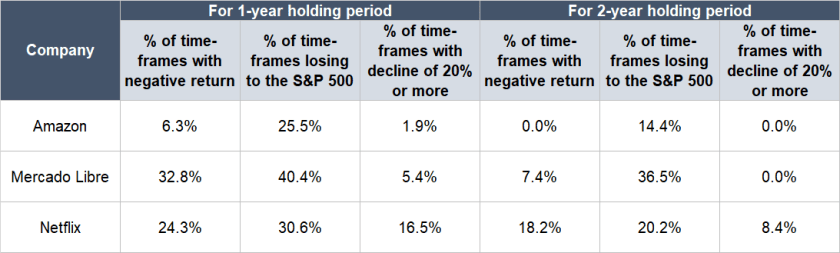
How To Judge If You Are a Good Long-term Investor

Just because your portfolio is up a lot over a short time frame does not make you a good long-term investor. Here’s what really matters.

There’s a corner of the Twitter universe that has become a “digital hangout” for investors. Affectionately known as FinTwit, this is a platform where investment professionals, hedge fund owners, billionaires, and even retail investors express their thoughts on investing.

I’ve become an avid follower of many of these FinTwit accounts and have learnt so much from them. In fact, I consider FinTwit a great avenue to learn from investors from all walks of life.

Bad habits

That said, there are some well-followed FinTwit accounts that have developed bad habits. 

One of these bad habits is to sing about short-term gains on stocks.

For the momentum trader, this may be a justifiable indicator that they have made the right trades. But for the long-term investor (which is a strategy that most of these FinTwit accounts I follow prescribe to), short-term stock price fluctuations mean little.

Boasting about steep share price increases, without any meaningful change in the business fundamentals, is actually not a good indicator of whether your investment thesis was right in the first place.

Judging your investments

Just because a stock’s price has gone up significantly in the last day/month/year does not make you correct. If the stock price appreciation was not fundamentally backed up by strong business metrics, your investment returns could merely have been due to luck or simply a change in view among other market participants.

Two cases in point are the meme stocks: Game Stop and AMC. The two companies have seen their stock prices rocket this year as retail investors piled into them, artificially bloating their valuations.

If you made a big return on these two companies because you thought that they were good long-term investments and you think that the current stock price makes you right, then you are sorely mistaken. The stock prices of Game Stop and AMC increased largely because a hoard of retail investors pooled together to try to make a point. You were probably just lucky to catch the ride.

So how then should we judge if we are actually good long-term investors? 

Instead of looking at near-term stock price fluctuations, I focus on whether the investment thesis of the underlying business is correct. What I consider a good indicator of good stock picking is when the companies I have a stake in report growing revenue, profit, and free cash flow over a multi-year period. This is a better measure of whether I’ve picked the right companies to invest in. If a company can grow its free cash flow at a healthy rate over time, its stock price will likely keep growing, as long as the initial valuation was not too expensive.

The bottom line

Near-term stock price fluctuations merely reflect a changing appetite for the stock among stock market participants and usually only represent changing valuation multiples.

A better indicator of long-term investing success is whether the underlying business continues to outperform and grow over many years. Ultimately, business performance, and not investor perception, will be the main driver of long-term sustainable stock price growth.

Disclaimer: The Good Investors is the personal investing blog of two simple guys who are passionate about educating Singaporeans about stock market investing. By using this Site, you specifically agree that none of the information provided constitutes financial, investment, or other professional advice. It is only intended to provide education. Speak with a professional before making important decisions about your money, your professional life, or even your personal life. I currently have no vested interest in the shares of any company mentioned. Holdings are subject to change at any time.

What We’re Reading (Week Ending 19 September 2021)

The best articles we’ve read in recent times on a wide range of topics, including investing, business, and the world in general.

We’ve constantly been sharing a list of our recent reads in our weekly emails for The Good Investors.

Do subscribe for our weekly updates through the orange box in the blog (it’s on the side if you’re using a computer, and all the way at the bottom if you’re using mobile) – it’s free!

But since our readership-audience for The Good Investors is wider than our subscriber base, we think sharing the reading list regularly on the blog itself can benefit even more people. The articles we share touch on a wide range of topics, including investing, business, and the world in general.

Here are the articles for the week ending 19 September 2021:

1. Zhang Yiming’s Last Speech – Kevin Xu

Last year was a very special year, with various emergencies, including the novel coronavirus pandemic. The resulting chain reaction was very volatile, and I believe we all felt it. Many people like to say that “quiet years are good years” (岁月静好), but in my opinion, the world is dynamically changing at an accelerated pace. We can see a lot of news every day, and it is very noisy.

Therefore, I would like to talk about the topic of “ordinary mind” today. In the face of a dynamically changing world, we are often anxious, worried about the future or upset about the past, and a lot of energy and time are wasted on facing volatilities. In the past, there were more discussions on methodology in the industry, and we all attached great importance to it. But I think that in such an environment, keeping an ordinary mind is something that sounds simple but important.

I think people who keep an ordinary mind are more relaxed, have no internal distortions, observe things with a more nuanced perspective, are practical, and have more patience. They tend to get things done better. Most of the time, people are able to have good judgment without paranoia or distractions. There is a saying, “本自具足”, which means “it has always been complete and sufficient, and lacked nothing”. The theme of our anniversary this year is “Remain Grounded, Keep Aiming Higher”. My understanding is that these two sentences are similar in meaning. Only when the mind is smoother and more stable, can it be more firmly rooted, and only then can it have the courage and imagination to do things that are more difficult to reach…

…The word “ordinary mind” is a word of Buddhist origin, and there are many such words in Chinese, such as “精进” (dedicating oneself to refinement or progress) and “想入非非” (daydreaming). The definition of “ordinary mind” in the encyclopedia is: “to remain unbiased and not paranoid under all circumstances and in all actions”. In modern psychology, there are also some explanations that basically mean, “doing one’s best, going with the flow, and staying calm”. If you search the headlines, you can also find other articles, concepts and explanations, such as let it be or let it go, common sense, intuition, and righteousness and sincerity. For example, the saying “不离日用常行内,直到先天未画时” (the supreme principle is buried in one’s mind) is actually about intuition (or intuitive conscience). In the Internet tech circle, there is also the popular saying, “return to the basics, seek truth through facts” and acceptance of uncertainty.

If you use the most straightforward words, an “ordinary mind” is: “when hungry, eat; when tired, sleep.”…

…The first thing I would like to say about the ordinary mind is, treat yourself with an “ordinary mind “. The most basic thing is to realize that everyone, including yourself, is an ordinary person.

Some media want to add drama when they report on startups and people’s stories, either by making the experience seem legendary or by dramatizing people’s characters. When I used to be interviewed, people also wanted me to share twists and turns. I often said it was nothing special. In fact, most things, in my opinion, have reasons and justifications. Nothing is particularly that difficult or unusual to explain.

It’s really true. As our business has grown, I have gotten to know more and more people, including many very special and capable people. One of my own feelings is: maybe there are some differences in knowledge and experience, but from a “human” point of view, we are still very similar to one another — we are all ordinary people. But there is one thing that is different. For people who achieve great things, they often maintain a very ordinary mentality. In other words, if you keep an ordinary mind, accept yourself as you are, and do well for yourself, you can often do things well.

Ordinary people can do extraordinary things…

…Two years ago, I heard about a best-selling book called “The Power of Now” on Open Language. The book has this passage:

All negativity is caused by an accumulation of psychological time and denial of the present moment. Unease, anxiety, tension, stress, worry, all forms of fear are caused by thinking about the future. Guilt, regret, resentment, grievances, sadness, bitterness, all forms of non-forgiveness are caused by worrying about the past…

…Two years ago, there was a documentary that was very popular called “Free Solo”. I met the main character, Alex Honnold, when I was in California. Many people shared his story, but the thing that struck me the most was that it was dangerous to go forward and backward, but it was most dangerous to have a weak leg and a confused heart. In the process of rock climbing, you can’t look back too much and be afraid of what’s behind you, or keep thinking about a wrong step taken. Nor can you look forward and realize that there is still such a long way to go. One thing is very worth learning from Alex: he was very focused on the present moment at every moment.

Free soloing is an activity with such high uncertainty that few people will ever have that experience. I myself had one of a much more ordinary, but similar feelings. I used to have a hard time sticking to running or swimming. Running for two kilometers was very difficult for me. Then I was thinking, what is it that makes me unable to run? It was actually the aversion to running, that fatigue or worry, that made me nervous. Later, I tried to run without thinking about anything else, except for the necessary adjustment of breathing. I tried to use only the necessary muscles, relax as much as possible, and ignore the interference of soreness. Then it became easy to run 3 km, 4 km. Later I used this same method to practice swimming. Originally, I could only swim 500 meters, but now I can easily swim up to 1,000 meters, not because my physical ability has improved, but because, I feel, I have removed the attrition in the middle. I stopped worrying about whether I could finish the swim, whether I was well-rested yesterday, or whether I was in good shape today, and was able to run better. 

2. If Your CEO Talks Like Kant, Think Twice Before Investing – John Authers

We’re used to crunching numbers in investments. With the improvement in technology to analyze language, Big Data now allows us to start crunching words as well, and it turns out to be very useful. If you want to get someone to invest, make your case in clear language. And for those thinking of investing, if someone pitching to you can’t explain their offer in plain speech, that is a sign not to invest. 

This is the fascinating finding from research by the quants at Nomura Holdings Inc., looking at earnings calls. (The language in 10-Ks is always carefully vetted and written by committee. Such documents tend to be written in bad, complicated prose. But when executives are speaking on a call, they have the liberty to make straightforward points in a simple way.)

The results are dramatic. The researchers analyzed the language used by execs in calls for all the companies in the Russell 1000 large-cap index, and split them into 10 groups of 100. Since 2014, the 100 companies whose officers used the most complex language averaged a return of 9.45% per year. The companies in the simplest language decile returned 15.4% per year. The results are robust when controlled for volatility, with the simple language decile having a far higher Sharpe ratio…

3. Only The Rich Are Poisoned: The Preference of Others – Nassim Nicholas Taleb

When people get rich, they shed their skin-in-the game driven experiential mechanism. They lose control of their preferences, substituting constructed preferences to their own, complicating their lives unnecessarily, triggering their own misery. And these are of course the preferences of those who want to sell them something. This is a skin-in-the-game problem as the choices of the rich are dictated by others who have something to gain, and no side effects, from the sale. And given that they are rich, and their exploiters not often so, nobody would shout victim.

I once had dinner in a Michelin-starred restaurant with a fellow who insisted on eating there instead of my selection of a casual Greek taverna with a friendly owner operator, his second cousin as a manager and his third cousin once removed as a receptionist. The other customers seemed, as we say in Mediterranean languages, to have a cork plugged in their behind obstructing proper ventilation, causing the vapors to build on the inside of the gastrointestinal walls, leading to the irritable type of decorum you only notice in the educated upper classes. I note that, in addition to the plugged corks, all men wore ties.

Dinner consisted in a succession of complicated small things, with microscopic ingredients and contrasting tastes that forced you to concentrate as if you were taking some type of exam. You were not eating, rather visiting some type of museum with an affected English major lecturing you on some artistic dimension you would have never considered on your own. There was so little that was familiar and so little that fit my taste buds: once something on the occasion tasted like something real, there was no chance to have more as we moved on to the next dish. Trudging through the dishes and listening to some b***t by the sommelier about the paired wine, I was afraid of losing concentration. I costs a lot of energy to fake that I was not bored. In fact I discovered an optimization in the wrong place: the only thing I cared about, bread, was not warm. It appears that this is not a Michelin requirement…

…Now let us generalize to progress in general. Do you want society to get wealthy, or is there something else you prefer –avoidance of poverty. Are your choices yours or those of salespeople?

Let’s return to the restaurant experience and discuss constructed preferences as compared to natural ones. If I had a choice between paying $200 for a pizza or $6.95 for the French complicated experience, I would pay $200 for the pizza, plus $9.95 for a bottle of Malbec wine. Actually I would pay to not have the Michelin experience.

This reasoning be have just shown that exists a sophistication that causes degradation, what economists call “negative utility”. This tells us something about wealth & the growth of “GDP” in society: this shows the presence an “S” curve beyond which you get incremental harm. It is detectable only if you get rid of constructed preferences.

Now many societies have been getting wealthier and wealthier, many beyond the positive part of the “S” curve. And I am certain that if pizza were priced at $200, the people with a cork plugged in their behind would be lining up for it. But it is too easy to produce so they opt for the costly, and pizza will be always cheaper than the complicated crap.

4. Scientists created the world’s whitest paint. It could eliminate the need for air conditioning. – Tribune News Service

The whitest paint in the world has been created in a lab at Purdue University in the US, a paint so white that it could eventually reduce or even eliminate the need for air conditioning, scientists say.

The paint has now made it into the Guinness World Records book as the whitest ever made.

So why did the scientists create such a paint? It turns out that breaking a world record wasn’t the goal of the researchers – curbing global warming was.

“When we started this project about seven years ago, we had saving energy and fighting climate change in mind,” said Xiulin Ruan, a professor of mechanical engineering at Purdue, in a statement…

…The paint reflects 98.1 per cent of solar radiation while also emitting infrared heat. Because the paint absorbs less heat from the sun than it emits, a surface coated with this paint is cooled below the surrounding temperature without consuming power.

Using this new paint to cover a roof area of about 1,000 square feet could result in a cooling power of 10 kilowatts.

Typical commercial white paint gets warmer rather than cooler. Paints on the market that are designed to reject heat reflect only 80 per cent to 90 per cent of sunlight and cannot make surfaces cooler than their surroundings.

5. Forget the Stock Market. The Rare-Plant Market Has Gone Bonkers. – Shan Li

The 1600s had the Dutch tulip market bubble. Now 2020 is doing the same for rare plants.

Interest in greenery has grown during the pandemic, with more people stuck at home and bored—and Instagram posts have helped send the market for unusual varieties into a tizzy. Growers, nurseries and plant shops are scrambling to keep up. The most coveted flora now fetch thousands of dollars. Plant flippers have jumped in to make a quick buck.

Jerry Garcia, a 27-year-old aircraft mechanic in San Diego, said in recent months he has been besieged by requests from people eager to buy a piece of his vast tropical-plants collection. During one week in August, he sold two small cuttings of a highly coveted Variegated Monstera Adansonii plant for $2,000 apiece. With proper care, the cuttings will eventually turn into plants.

“It’s better than the stock market,” Mr. Garcia said. “I got a bunch of these plants when they were in the double digits, and now they are in the four-digit realm.”…

…Flora with sought-after features, such as splashes of color and holes in their leaves, are often the result of genetic mutations that make them susceptible to minor changes in temperature, humidity and light, plant experts say.

The ghostly white streaks of the Variegated Monstera Albo can send prices up to $250 per leaf. Those same colorless patches, however, mean the plant has trouble photosynthesizing and often requires extra help from humidifiers or grow lights…

…Longtime plant lovers say the craze for rare plants is reminiscent of a housing bubble, or the tulip mania that gripped the Netherlands during the 1600s, when bulb prices hit stratospheric heights before crashing.

“It’s going to burst at some point,” said Ms. Barnum. “It’s too crazy.”

Botany bandits are interested, too. A few months ago, Mr. Garcia, the San Diego collector, began noticing that valuable plants were disappearing from his rented greenhouse. He set up motion-activated cameras to figure out what was happening. Those gadgets began vanishing as well.

Mr. Garcia almost did a stakeout in a hammock, but decided to splurge instead on a camera that sent live footage to his phone. It caught a man, toting a gun, making off with thousands of dollars worth of plants.

“This man was picking up plants as if he was shopping at a nursery,” said Mr. Garcia, who quickly moved his collection back home.

6. Jack Ma’s Costliest Business Lesson: China Has Only One Leader – Keith Zhai, Lingling Wei and Jing Yang

Technological disruption, once seen as a useful prod for China to catch up with the West, has been recast as a threat to the ruling Communist Party. As a result, Xi Jinping, China’s most powerful leader in decades, is rewriting the rules of business for the world’s second-largest economy.

Mr. Ma failed to keep pace with Beijing’s shifting views and lost an appreciation for the risks of falling out of step, according to people who know him. He tuned out warnings for years, they said. He behaved too much like an American entrepreneur.

Mr. Ma’s exit from the world stage followed a typically frank speech in October, when he criticized Chinese regulators for stifling financial innovation. Mr. Xi personally intervened days later to block the record $34 billion-plus initial public offering of Ant Group, Mr. Ma’s financial-tech company. Since then, Ant has been forced to restructure its business, leaving the company’s employees and investors in limbo.

Beijing has cracked down on China’s private sector, issuing fines and initiating probes meant to force Mr. Ma’s companies, as well as such firms as ride-hailing giant Didi Global Inc. and TikTok owner ByteDance Ltd., to adhere more closely to the state’s interests. The companies, holding troves of capital and user data, had grown too expansive for the government to control…

…Alibaba boomed in the late 2000s, and Mr. Ma appeared on posters and TV screens hung in convenience stores and at airport and railway waiting areas across China. Millions watched him issue his prescriptions for success. “The success or failure of a company often depends on if the founder could follow his heart,” he said in one early speech.

Government officials hailed his work. One was Mr. Xi, who by the early 2000s had become the top leader of Zhejiang province, where Alibaba is based. Mr. Xi promoted startups, in line with Chinese policy at the time.

“He encouraged companies like Alibaba to expand because they’re good for the country,” a former Zhejiang official recalled. After Mr. Xi left Zhejiang in 2007 to be Shanghai’s top official, he visited Alibaba and asked, “Can you come to Shanghai and help us develop?” state media reported…

…Backed by success, Mr. Ma grew more bold and had few people to hold him back. He touted Alipay, the online payment service he created for transactions on Alibaba’s e-commerce platforms, even though it threatened the dominance of China’s state-owned banks.

Chinese banks weren’t doing enough to support small businesses, Mr. Ma said, because they focused too much on state-owned enterprises. “If the banks don’t change, we’ll change the banks,” Mr. Ma said at a 2008 conference.

After Mr. Xi became president in 2013, the freewheeling atmosphere in the private sector that had prevailed under China’s previous leaders, Jiang Zemin and Hu Jintao, began to thin. Mr. Xi announced that “state-owned enterprises cannot be weakened, but must be strengthened.”

The shift in Beijing coincided with Mr. Ma’s global ascent—and he didn’t appear to notice the change.

7. Gabriel Leydon – Designing Digital Economies – Patrick O’Shaughnessy and Gabriel Leydon

Patrick: [00:04:10] I know you’re going to restrain yourself, but we’ll do our best. The first red pill of the discussion is around the topic of design. There’s a huge emphasis on design right now, and I think you’ve got an interesting take on what an emphasis on design means about where we are in capitalism. What are your thoughts on the importance of design or what it might mean?

Gabriel: [00:04:30] I see this push for, you see a lot of people, they’re making productivity apps and they’re claiming it’s a game now. I see things going in this pattern where when things are innovative, nobody really cares what they look like. If I made up a teleport machine and it was the size of an arena and it was covered in slime and smelled really bad or something, I don’t think anybody would care. There’d be a line around the block. Everybody would just jump in and they would think it’s the greatest thing ever. But over time we kind of would make it smaller, and then the artists would come in and try to make it look nicer and feel better. And once you kind of get to that design phase, Silicon Valley’s been in for about 10 years, there’s only so much you can do to make something look better.

If you remember 5 years ago, everybody was talking about delighting their users, and delighting was just like, “We don’t have any more ideas. So we’re just going to feel a little bit better because we’re out of ideas. So now we’re going to just delight you.” And the game design stuff is, “we don’t know how to make this look better, so now we’re just going to tap into your human condition of biology and psychology to make our products better. Because we don’t know how to make them more innovative, we don’t know how to make them better looking, but we can add levels and achievements.”

How that presents itself is all of a sudden you’re getting achievements for buying erectile dysfunction pills from Hims. You buy extra orders of minoxidil to max out your Hims account. That’s sort of what we’re seeing. And it’s funny too because that’s all I’ve been doing for 20 years, is that kind of stuff. And while I was doing it, I just thought I was wasting my time working on video games. I thought you have Google’s being built around you and Facebook and all this stuff, and here you are making video games and you just feel like the losers of technology. The losers make video games, and it’s kind of true in a lot of ways. But recently it’s kind of like everything’s turning my way. Everything’s becoming, you see this kind of talk about everything becoming a video game, and it’s pretty bizarre to me because it even caught me by surprise. 20 years feeling like you’re wasting your time, and then all of a sudden feeling like, “Hey, am I really good at the world’s most important skill all of a sudden?”

It’s very interesting, but I actually see it as a bad sign. We’re basically running out of new ideas. The economy is just becoming more and more psychological and it’s less about innovation and more about understanding your condition as a person and then building a product around biological and psychological reflexes rather than a teleport machine that can move you around the world. So I think you’re seeing more and more of that…

Patrick: [00:48:44] Can you say a bit about the experience with RT platform? Think some of the technologies that you built.

Gabriel: [00:48:49] My personal obsession has been trying to create the most amount of human interaction as possible on an app. Everything that I’ve done online has been an app about trying to get the whole world on one screen. That’s my goal, is I want 8 billion people on the same screen at the same time. And then I want to just do crazy stuff with that. Because I think that’s the perfect manifestation of the internet. It’s like, put everybody on the same screen. We’re all connected. So, let’s all get on the same screen. So it sounds kind of crazy. But to me, it just seems like the logical outcome of the internet. Is we just all ended up on the same screen and looking at the same thing at the same time. And that’s what I want to do, is try to create a real-time layer between everybody and make all that work very, very hard.

But the other thing that I think that’s really interesting, kind of like change of topic, that you mentioned, I’m really excited about NFTs. Because I see a clear trajectory from in-app purchases to NFTs. Where we were the first game on the Apple platform to have in-app purchases in a game called Race or Die at the time. And then we made another game called Original Gangsters. That was the first one that we made for in-app purchases. It was transformative. It was insane. The idea that people can be in the app, they have their credit card hooked up, and they could just press a button, essentially. Put in their password, put their thumbprint, look at a camera and spend $1 to $100. Totally changed everything when that happened. I mean, our revenue went from selling apps. It went up about 700% overnight. As soon as we put in-app purchases in the game. So, it’s crazy.

As a video game developer, the reason why that works is because I have a centralized economy. I have servers. I have server security. I have a total monopoly on my virtual goods. If you want to buy one, you can’t buy it from anybody else. You have to buy it from me. And if you try to hack my server, you can’t. You just have to buy it. There’s no other way. We would make items, make new stuff for the game. And they would make millions of dollars in an hour. And the thing that enabled that ultimately, was all the security around the item. They had to buy it from me. And now we’re seeing NFTs. Where, instead of the game developer creating the security around the item, we have Ethereum creating security around the items.

So, literally, everybody on earth now has the same monetization abilities that a video game has. And you’re seeing the same results, like Blau doing $11 million of MP3s in a few hours. That’s what video games do. So this guaranteed scarcity, guaranteed ownership, perfect security, or near-perfect security at least, around these virtual objects are the next iteration of the in-app purchase that will invade every single software business there is. Everybody’s going to start looking like a gaming company. If you can get an audience together and you can create demand around the virtual object, you now have Ethereum as your security model and you can control whether somebody can buy it from you or not.

I see everyone, and it’s sort of this thing that you can’t avoid too because it’s all margin. It’s like a 100% profit. They’re all virtual objects. So I actually see everybody getting into this. Even your local cafe. Everybody’s going to be doing this because you can, and because it will make a lot of money. And it’s going to come down to, going right back, this is what I meant. Last year I was feeling like, oh gosh. All this video game experience. I was applying it to some friends or whatever. There were some things I’ve worked on and it worked really well on. So I felt kind of good. It’s okay. Works on other stuff. But when I saw this, I was like, oh my God. Is everybody going to be running a live ops team? And the answer is, yes. Everybody is. Everybody’s going to say, get online at noon and buy 1 of 30 of these things that unlocks access to the VIP room, the events, the whatever, whatever.

And not only that it’s superior to the in-app purchase because it’s tradable and it’s speculative. When people are buying stuff in a free to play game, the only thing they get in return is the experience. That’s it. If they stop playing the game, that’s it. They don’t get anything. They just get nothing. But they get the experience and it’s good enough. It’s good enough to be $80 billion a year. Just for the experience. So what happens when these things are tradable and speculative, and guaranteed rare. I think it 10x’s or maybe actually more. I think that people are vastly underestimating what’s about to happen. They don’t see it in their regular life. They don’t work in businesses that do this kind of stuff.

So I think it’s inevitable and it will happen slow and fast. Fast in a video game, but slow everywhere else. Because there’s not enough people that understand this stuff. There really isn’t. I mean, there are people who are okay at it. And then there are people who are really, really good at it. There’s just not enough. And there’s no school to go to either. It’s all experience-based and intuition. So the world isn’t going to turn into a video game overnight. Because there’s just not enough people to do it. But I do think it is inevitable that everybody starts selling these virtual objects because they can. They can be designed in ways that unlock crazy amounts of profits that are just, I mean, this sounds really extreme but I think that you’ll start seeing more and more businesses adopt loss-leader or free to play models. The price of coffee could go down because they make more money on the NFT. That sounds-

Patrick: [00:54:20] Crazy

...Patrick: [01:01:04] Give me one more thing at least. One more what I would call purple pill. Something not too inflammatory. Something you think that is true about the world that people wouldn’t like to hear.

Gabriel: [01:01:14] I think we need AI more than we think. I think that we’re at an IQ limit and the reason why innovation feels like it’s slowing down is because we can’t do it. We just literally, physically can’t do it. And there may be an exit ramp through AI, but it’s not exactly clear that we can do that either.

I really think that the 60s and 70s futurism is the reason why we’re suffering so much today. Because there was no reason to not print money, to not full-on inflationary mindset and everything because we were going to live in paradise. We were going to be on the moon. We’ll be able to pay all this back, there’s no problem. And then financialization happened, and gamification of financialization happened because that was easier and it worked. But it’s not better. Innovation is better. It’s clearly better. If I make a teleport machine, I don’t need to make a video game, I don’t need to have levels and achievements. It doesn’t need to look nice. It doesn’t need any of those things. It’s just is what it is and everybody wants one. That is better. That’s the only way to really have prosperity. And this design/now gamification is a symptom of the limits of our minds. So instead of doing things in the physical world, we’re doing things in the psychological world now, and that’s may be permanent. And I hope that’s not true, but more and more of the economy is going into this exploit, automation, high-frequency trading, that kind of thinking. And it’s not rockets to Mars.

We’ve gotten to the point where we look at the two richest men… Like we used to have the Wright brothers, these two guys trying to make an airplane, they’re in the middle of nowhere, who are these guys like? Now we look to the two richest men in the world to solve our most difficult problems. The regular person has no chance in participating in the future of the economy now. The only people who have the chance like, “I hope Bill Gates figures out solar panels.” And the regular people are just kind of looking up to them saying, “Well, I don’t know what to do.” And I think the reality is the rich guys don’t know what to do either. We got the rockets going. Those are cool. And we’re making some incremental innovations. There’s been some really important things like crypto. So it’s not hopeless. It’s just not what we thought was going to happen. So I think that’s the dislocation between the economy and the reality of innovation is that the economy moved way ahead of innovation, under false expectations that we would be able to keep innovating at an exponential rate.

I think there’s a fear that we know that we can’t. So then you’re staring at deflation like a reset, essentially. We’ve got too much of everything and there’s not enough innovation to pay this back. It doesn’t exist so we got to abandoned ship basically. That’s pretty bad. But from my lens, from my point of view, it’s like that’s why gaming is becoming so important. It’s because we don’t have the teleport machine and we need one. And if we had teleport machines, nobody would be playing games.


Disclaimer: The Good Investors is the personal investing blog of two simple guys who are passionate about educating Singaporeans about stock market investing. By using this Site, you specifically agree that none of the information provided constitutes financial, investment, or other professional advice. It is only intended to provide education. Speak with a professional before making important decisions about your money, your professional life, or even your personal life. We currently have no vested interest in any companies mentioned. Holdings are subject to change at any time.

Should You Buy Shares of Manchester United?

Did you know that you can become a shareholder of Manchester United? But the fact that you can doesn’t mean that you should. Here’s why.

When news that Manchester United re-signed Cristiano Ronaldo broke a few weeks ago, the football club’s stock price climbed by 10% in just a few hours.

As a big football fan, this got me curious on the economics of a football club. I decided to do some research to find out if a stock like Manchester United (NYSE: MANU) is really worth considering.

This article is about what I found out. For full transparency, I should state that I am a Liverpool fan. But don’t worry, I didn’t let that influence (I hope) my analysis of Manchester United’s stock. So let’s begin.

How Manchester United and other football clubs make money

Football clubs like Manchester United boast a huge and international fanbase. The fans are the reason behind the club’s ability to generate hundreds of millions of pounds in revenue. Football clubs earn money directly from fans by selling merchandise to these fans.

The fans are also what drive the commercial appeal of a football club. Sponsors pay tens of millions of pounds to have their logo on Manchester United’s kit. This makes sense, as sponsors know that fans will be watching the team play and having their brand on a big-name club like Manchester United is a great avenue for brand marketing.

Manchester United also competes in some of the biggest football competitions in the world, which fans around the world want to watch. These competitions -such as the Premier League and the UEFA Champions League – negotiate massive broadcasting deals with broadcasters. Some of the money from these broadcasting deals are distributed to the football clubs who play in these competitions. 

Lastly, clubs also earn from matchday revenue, which are derived from ticket and other matchday-related sales to attendees. Old Trafford, Manchester United’s fully-owned stadium, can seat 74,140 fans and is one of the largest football club stadiums in the United Kingdom. In the pre-COVID days, Old Trafford was consistently 99% full during matchdays. 

The chart below shows the revenue breakdown of Manchester United in the financial year ended 30 June 2020 (FY2020).

Source: My compilation from annual reports

Costs of running its business

With its massive fanbase, and as one of the most popular clubs not just in the UK but across the globe, Manchester United has no problem generating revenue year after year. But the cost of running a club like Manchester United is the real sticking point if you are looking at it as an investor.

In order to remain a competitive football club and to win fan appeal, the club has to spend significant dough to sign the top (and most marketable) players. Buying a player from another club can cost tens of millions, and even hundreds of millions, of pounds. In addition, in order to retain and attract talent, Manchester united needs to pay highly sought-after players extremely competitive wages that can go up to hundreds of thousands of pounds a week.

In FY2020, Manchester United’s wages and other employee benefit expenses amounted to a staggering £284 million, or 55% of revenue.

On the income statement, money spent on acquiring players is not immediately recorded as an expense. Instead these expenses are capitalised on the balance sheet and amortised over time, which can significantly distort the profitability of the club. Player sales may also artificially distort operating profits for a particular year. As such, I prefer to look at the cash flow statement to see if Manchester United has been able to generate a growing stream of cash flow over the years. The chart below shows Manchester United’s free cash flow from FY2015 to FY2020.

Source: My compilation and computation from figures from annual reports

To calculate free cash flow, I took operating cash flow and deducted capital expenses (the bulk of it is for stadium upkeep) and the cost of player purchases, and added back the amount earned from player sales.

From the chart, we can see that Manchester United’s free cash flow can be fairly unpredictable. This is due to the unpredictability of player purchases and player sales.

Another wildcard is that the club’s operating cash flow is also not stable as some of the broadcasting revenue from certain competitions depends on the club’s progress in these competitions. This creates a further degree of uncertainty. For example, during the 2017/2018 season, Manchester United exited the Champions League in the group stages, which resulted in lower operating cash flow for the year.

To make matters more complicated, Manchester United is also not guaranteed entry into the UEFA Champions League each year – entry into the tournament largely depends on the club’s position at the end of the season in the Premier League. The UEFA Champions League is a major source of revenue for the club. During the 2019/2020 season, on top of a loss of matchday revenue because of COVID, Manchester United also did not qualify for the Champions League and only played in the Europa League, which resulted in lower revenue and operating cash flow.

Balance sheet

Due to the unpredictable nature of a football club’s cash flow, I believe its balance sheet needs to be fairly robust.

Unfortunately, Manchester United again seems thin in this area. The club ended 31 March 2021 with £443.5 million in net debt consisting of around £84.7 million in cash and £528.2 million in debt. Throw in the amount Manchester United paid in July and August this year for signing a few star footballers in Cristiano Ronaldo, Jadon Sancho, and Raphael Varane, and the club’s net debt likely has increased further.

Although the signing of Ronaldo should bring in more commercial revenue for Manchester United, the club’s financial standing still seems risky, given the high cost of running a football club and the unpredictable nature of its cash flow.

My thoughts on Manchester United as an investment

Owning shares of a football club like Manchester United may seem like a novelty and a great conversation starter. But the unpredictability of its business makes it an unappealing investment to me.

The club is in a constant struggle to balance profitability and keeping the fans happy. But its profitability and its fans are inextricably linked as fans are the main reasons for the club’s commercial success in the first place. Upset this balance and the empire comes crashing down.

From a valuation perspective, Manchester United currently has a market cap of around £2.08 billion. To me, this doesn’t seem cheap. In the six years ended 30 June 2020, the club only generated a cumulative £53.3 million in free cash flow or an average of around £8.9 million per year. This translates to a price-to-average free cash flow ratio of 225.

In the nine months ended 31 March 2021, the club had negative free cash flow of £10.9 million. And given the recent player purchases of Ronaldo, Sancho and Varane, I think it will end the year with even more cash burn. 

Although there is always the possibility that a rich businessman may offer a premium valuation to take the club private simply for the media publicity and the novelty of owning a club like Manchester United, the numbers from a business perspective are not appealing. Although I’m a huge football fan, I’m definitely not a fan of investing in Manchester United.


Disclaimer: The Good Investors is the personal investing blog of two simple guys who are passionate about educating Singaporeans about stock market investing. By using this Site, you specifically agree that none of the information provided constitutes financial, investment, or other professional advice. It is only intended to provide education. Speak with a professional before making important decisions about your money, your professional life, or even your personal life. I currently have no vested interest in the shares of any company mentioned. Holdings are subject to change at any time.